
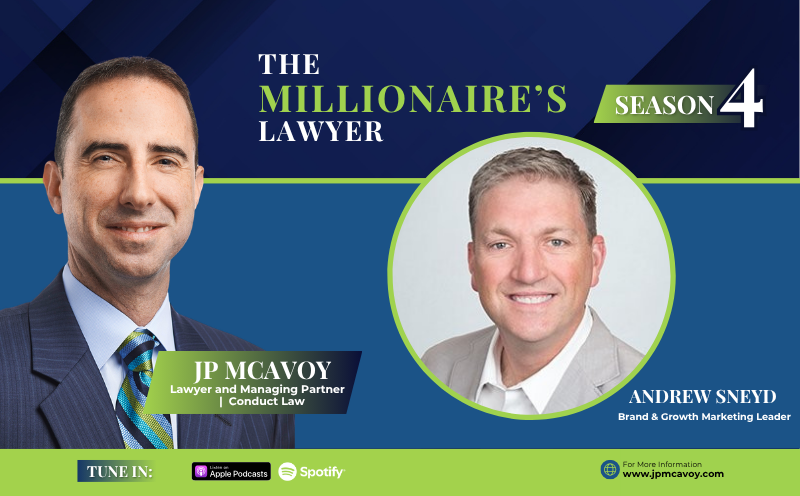
The New Playbook: AI Marketing, Risk, and Regulation with Andrew Sneyd
“Great marketing knows that you got to solve that busy, distracted customer first.” —Andrew Sneyd
Inbox feeds and streaming ads now respond to real-time data and machine learning, not just clever copy. That shift is creating sharper personalization, faster creative cycles, and a new kind of legal and ethical tension in industries that sit close to the edge, like sports betting and prediction markets. This episode sits inside that tension and unpacks what is really happening behind the scenes.
Marketing leader Andrew Sneyd has led brands at Kraft, Anheuser-Busch, Priceline, and FanDuel, where AI and big data turned traditional campaigns into high-frequency, high-stakes decision engines. His path from Toronto brand teams to C-level roles in New York highlights how constrained budgets, regulatory pressure, and experimentation with AI have shaped his view of what modern marketing should be.
Explore this conversation to understand how AI-driven personalization, branding craft, and emerging regulation intersect right now, including:
- How FanDuel used AI and data to send a billion targeted emails and test creative at scale
- Dynamic legal disclaimers and other “unsexy” automations that changed the game
- The role of sound, color, and mnemonic devices in cutting through media clutter
- How prediction markets are disrupting traditional sportsbooks and regulators
- The growing gap between rapid tech change and slow-moving lawmaking
- What hyper-personalized connected TV and streaming ads already know about households
- Why starting in the Canadian market became a hidden edge for global CMOs
Episode Highlights:
- 01:19 The Evolution of Marketing and AI Integration
- 05:41 Leveraging AI for Marketing Efficiency
- 10:12 The Future of AI and Marketing
- 11:57 The Impact of AI on Consumer Behavior
- 14:46 Branded Breakthrough and Mnemonic Devices
- 21:05 Personalizing Consumer Engagement
- 25:37 Balancing the Constant Tension
- 27:31 The Speed of Regulation
- 33:11 Set Up the Controls Over Your Data
Resources:
Get Your Copy of JP’s Book
The Millionaire’s Lawyer: Grow and Sell Your Business for Maximum Profitability
Quotes:
05:38 “Some of the behind-the-scenes, less sexy things are where some of the biggest impacts were made.” —Andrew Sneyd2
11:21 “Now, you can just ask your enterprise, AI version— incredible results that streamline and let marketers focus on innovation and creativity instead of just project management that occupies more than 50% of your time.” —Andrew Sneyd
14:03 “Great marketing knows that you got to solve that busy, distracted customer first.” —Andrew Sneyd
20:47 “Just by showing up in a consistent way, you now can use less time and have more time to be able to talk about what you’re offering.” —Andrew Sneyd
24:30 “To launch a prediction market in a legalized state is a straight-up affront to the folks that gave you your license, and it’s unclear whether or not they’d actually take it away if you tried to operate in prediction markets.” —Andrew Sneyd
32:29 “How you can have scaled personalization is changing so quickly that people don’t even realize that’s happening in their home, like as you’re watching YouTube TV as your way of watching television.” —Andrew Sneyd
33:20 “So just being aware of what’s coming, being aware of the influence of those as well… Be aware, reflect as to what’s occurring, and then make use of it.” —JP McAvoy
A Little Bit About Andrew:

Andrew Sneyd is a visionary marketing executive known for blending brand storytelling with data-driven growth to deliver exceptional commercial results. With early roots in Fortune 100 CPG, he has led transformative growth across direct-to-consumer and global brand ecosystems, owning P&L and building high-performance teams.
At FanDuel, he played a pivotal role in scaling the business into America’s #1 online gaming brand—expanding from 1M annual customers to 1M daily active users in just five years and capturing 45% of the U.S. sports betting market.
Previously, he reignited global momentum for Budweiser, reversing decline and driving revenue growth from $4B to $6B while establishing premium leadership across key international markets, including the UK, China, Russia, and Brazil.
TRANSCRIPTION:
Welcome to The Millionaire’s Lawyer where you’ll hear leading professionals share expert advice on how to grow your business and sell it for maximum profitability. If you want to learn lawyer proven strategies for building and exiting your business, then this is the podcast for you. Your host, JP McAvoy, is a Business Lawyer, College Professor, and Best-Selling Author who has been assisting clients start, grow and sell their businesses for millions of dollars for over 15 years. Will yours be the next? Now here’s your host, JP McAvoy.
JP McAvoy: Hi, and welcome. On today’s show, we’ve got Andrew Sneyd who’s an expert in all things marketing, from Craft to Anheuser Busch, to Priceline and FanDuel, Andrew has seen almost every aspect of marketing and understands how it has evolved over the years. Here’s my conversation with Andrew.
Andrew, thanks for joining us here today. Wonderful to see you, I guess from Westchester New York you’re checking in today, aren’t you?
Andrew Sneyd: Yeah. Good to see you, JP.
JP McAvoy: It’s been a while. We’ve chatted about doing this for some time now. And obviously, the stars have aligned. There’s a lot going on in this world. It was a very interesting time. As you peer in from your corner in New York, obviously, Canadians are watching with vested interests, all things going on. I want to steer the conversations toward the part of your expertise. One of the things you’ve honed over the years and how things continue to evolve with it, specifically marketing, and what we’re consuming on a regular basis. Take us through, I guess, to the position you’re doing now, and the way that you’re advising people from your marketing vantage point.
Andrew Sneyd: The pace of how things have changed, what a marketer can do? How to use the tools? How to be more efficient, like dramatically different things over the past 3 to 5 years. Two jobs ago, I was working at Priceline, and we started talking about big data and how AI can help. And certainly, they’ve revolutionized the customer service platforms that they use, and how they can be more efficient in servicing customers. And then most recently as the CMO at FanDuel, we saw a dramatic change. Incredible to see all the ways in which the teams could be more efficient. We could understand customers better. We could figure out how to be able to create content at pace way more efficiently. That was probably the most important need at FanDuel where every day, the reason to bet changes. There’s new games tonight, new interesting matchups. An internal team of 50 creative people were constantly creating what the new content is to be able to put into social media and into emails. It was incredible to see how big data and AI supported those efforts.
JP McAvoy: Yeah. So for the lay person, what is going on that they may not be aware of? Going back to early days, and we know messaging is the key, so it begins with a message, I’m sure. But then, as you say that AI and big data, what’s going on behind the scenes? What are the people that are really, really focused on this? What are they doing to direct messages to people?
Andrew Sneyd: Yeah. The first thing that happens is the promise of personalization has become quite real. And I’ll give you a few examples. We, at FanDuel, one of the secret sauce of why we got to leadership was being really precise about which customers got which nudges. We actually sent 1 billion emails in 2025. And you can imagine that there’s now an incredible support structure as to what should land in someone’s inbox that includes, hey, here’s the core of what we’re sending this targeted group of customers. Let’s say there’s a million emails that are about to go out. It would always be auto sent with up to 810 different headlines that in the first 5 minutes would be sent to 10,000 at a time groups with 8 to 10 different headlines. Which ones got opened and clicked the most sent the rest of them with that batch. And that could just happen at a scale that was impossible for someone to manually do it. So that’s one example. Another one was we operated in our difficult regulatory environment, 25 different state regulations for 25 different states.
And I think one of the biggest advantages we had that took a while for some of our competitors to catch on was we needed to put the right legal mandatory disclaimers in each of our ads. And so digitally, you’d have a very small space for this thing to show up on someone’s phone, and you can’t really put 25 different state disclaimers in some sort of a banner ad showing up. It’s all legal mumbo jumbo that flips in a role. And so we realized that we could use the same technology that let us know that someone was in a certain state so they were allowed to bet to also tell us how we should complete an ad. So we’d send out incomplete ads. And then depending on where they opened it, the right legal disclaimers would populate. So it was just the minimum need, and the rest of the ad could actually be what you were intending to show somebody. And that improved the effectiveness and also made it that we no longer had, oopsie, I sent the Ohio one to the Massachusetts customer. And now, I have to go tell the state regulator that we screwed up and sent a bunch of emails that didn’t, or ads that didn’t conform to the needs of the state. So that was a tremendous advantage. Some of those things behind the scenes, less sexy things are where some of the biggest impacts were made. And of course, more sexy things like, hey, we’re making ads. Famous people are in them. Famous people, whether it’s Rob Gronkowski, the Manning Brothers, Charles Barkley, they’ve been in lots of ads before. Let’s actually make an ad testing it already with their voices sitting in what we have to do. And so that started as, oh, my gosh, this is interesting. We can actually just put Rob Gronkowski’s voice into this spot, show it to him, see if he likes it. And then it ultimately turned into, hey, do you want to re-record this? It sounds perfect. You’re welcome to. And busy folks are like, no, I’m good. You can just air it like that.
JP McAvoy: That’s so interesting, Andrew. As you said it, yeah, spending time thinking and asking people about what we’re actually consuming, right? You just gave a real life example. The celebrities talking about how their likeness is something that they need to protect, it’s obviously something they can also leverage. And I think that what you just described is how you’re able to actually leverage that. How did you get enough of a voice to do that? And obviously, if you’re able to do it there, that is there, I think it can really be done at scale. Can it?
Andrew Sneyd: Basically, anyone whose voice has been in public enough, their voice could be leveraged by many different AI platforms to create content that comes out of their mouth that can be used for bad, as is seen all over the Twitter and other places. But it can also just be a helpful marketing tool where there’s a reason that the older gentleman that is the voice of the GEICO Gecko will live forever even after he dies. There’s been enough of his voice that they’ll be able to just make that work forever, and his family will benefit from that even after he passes. And so that’s a little bit strange, but definitely very efficient. You no longer have to book the $10,000 editing booth, send someone in to record, pay for someone’s time. There’s just so much efficiency that comes from the opportunity, especially in a fast paced world like sports betting, to turn on a dime and put up something interesting out of the voice of incredible athletes. So that’s just one example of places where we expected AI to work, and it did equally. Hey, I’d love to be able to do tonight, the Knicks are playing the Dallas Mavericks. Let’s throw a cowboy hat on Jalen Brunson and show him going into Texas. That stuff didn’t work very well. There’s still so much that needs to be improved in figuring out how to get to, even when you have the rights, having the rights to NBA and player equal treatment, and we had an NBA Players Association rights. So we had the ability to do that stuff. But the technology hasn’t yet caught up where it was great in delivering images, so there’s still a lot of evolution to happen where this will get even more efficient.
JP McAvoy: Brings to an interesting point as well. What do things look like in, I’m using 20 theories. I keep going to 20. I just think it’s sort of a nexus point. But then over the next couple of years, how do things continue to pace, accelerate the pace and usage of AI, but also what we’re going to be consuming? What’s that going to look like in a couple of years?
Andrew Sneyd: I think this first thing has just been eyes wide open curiosity and trying the things that felt like they would be interesting, customer facing, things that could be built. I think marketers are realizing that there’s so much more in the efficiency of how to run the shop that is less sexy. The example I shared of what more could be done for personalization, that doesn’t need to stop there. That was still, hey, here’s a group of people that currently bet on the NFL, and we need to figure out how to move them over to baseball or basketball now that those sports are moving out of season. That doesn’t need to be clusters of segments anymore. The system can be so good at figuring out how to be way more personalized for impact. And that personalization used to cost a ton of inefficiency. And now, it does not. So hopefully, as consumers, hey, that’s cool. That is actually what I’m looking for, and it fits what I want to do. Ads will become much more relevant, and then there’ll be less intrusive shouty at us that hopefully will just be way more valuable for what we’re looking for. So I think that’s on the horizon. And then the other part is just what it can do for enterprise, knowledge and insight. Like the back end of, I’ve seen incredible examples of moving away from traditional focus groups.
You know that world of like 8 people behind the glass sit there and find some interesting insights. Marketers can now just say, hey, I want the persona of these 8 people to live as an ongoing focus group in my business day. Hey, I just thought of something cool. Hey, what do you guys think of this idea? And it gives really great feedback on which type of people like it and which ones don’t based on the root needs that have been built up, and how the personas were created. That part’s crazy. The enterprise knowledge of it used to take a week to be able to amalgamate all the different sources in your company to try to understand and evaluate how a project or program performed. Now, you can just ask your enterprise AI version, keeping everything inside the shop, use all our data, plus you’re seeing in the world, and tell me how this program performed incredible results that just streamline, and let marketers focus on innovation and creativity, instead of just project management crap that occupied more than 50% of your time.
JP McAvoy: And that’s one thing we’re seeing across the board. It’s not specific to marketing. All industry is being impacted with the extra horse car that’s there to do a lot of the grunt work that was done previously, or had to be done previously. So we’re seeing that certainly occur. It’s interesting you talk about not quite as shouty. That’s an interesting way to think of it. Marketing is all about messaging, trying to get whichever message you wish to promote across. How much is the consumer influenced by that? How much are we now being influenced by the messages we receive? And does it become a self fulfilling thing the way we’re going in society, imparting a function of the messaging that we’re receiving on a regular basis?
Andrew Sneyd: Well, a marketer would want to say, almost completely. This is the function of what we do. Starting from just awareness that something exists to, hey, why might this fit better in your life? For relevance, this is unlike other things that maybe you’re using that are imperfect for differentiation, and then feeling closer to the brand. So taking people through that adoption of job one is cutting through the clutter. So we actually had a formula that we built at Anheuser Busch when I was running the Budweiser brand globally that was helpful to be able to understand, and keep ourselves grounded on what actually matters because the formula was half of the job, was just cutting through the clutter at being remembered, and correctly remembered as the right brand. Then there was the job of, is this a compelling message that brings you closer to the brand, and whatever metric was important based on how far advanced the brand was. And the final one was, is this persuasive? Is it actually going to sell anything? But you got to get through that first gate first. And being branded breakthrough, the ability for you to actually have a message that cuts through the clutter of everyone’s busy, distracted days where they’re inundated with messages, and correctly be connected with this category and this brand, people often want to jump to, let’s just shout this message at someone, and tell them they need to buy this one more time. Or whatever the thing might be. Great marketing knows that you have to solve that busy, distracted customer first.
JP McAvoy: Yeah. So interesting because you say that, and they just only seem to turn up the music. I know they’re not doing that, but that’s what it is.
Andrew Sneyd: How come the commercials got louder?
JP McAvoy: You know that’s not actually occurring. As a lawyer, I know that that’s actually not the case, but it just comes across that way. So yeah, it’s getting that messaging right from the beginning. When you say that first gate, what are the things that people identify with most? What are you trying to attach to?
Andrew Sneyd: Usually, there’s something within the brand that is like a device that helps. So Budweiser is the perfect example.
JP McAvoy: That’s the one they teach in marketing school, right? Because it’s been perfected in no small part to your efforts as well.
Andrew Sneyd: Well, no. There’s a legacy that I was able to carry forward one more step for a hundred years before I got there. But the ability for brands to have color cues, sound cues, visual mnemonic cues, characters, hey, you put a Clydesdale in a spot, boom. This is a Budweiser ad, immediately. So the brand breakthrough was done. What can we do now? We’ve got lots of time to get you warm and fuzzy about a puppy and a Clydesdale having this strange friend relationship. And here’s why it’s the beer you should drink for Super Bowl Sunday. The fact that you can get to branded breakthroughs quickly allows for better storytelling to happen for the rest of the 28 seconds of the spot. But yeah, there’s still the job to do of all brands being created. How do you build those mnemonic devices that are quick tools to be able to cut through and help people? I know what spot this is. I’m on board, and I’m appreciating who’s talking to me before they’re even trying to appreciate what we’re talking about.
JP McAvoy: What are some of those devices that’s so interesting? Because we get them, right? I guess it’s subconsciously, it’s been ingrained into us. But what are some of those things? What are those tools that are being used?
Andrew Sneyd: So at FanDuel, we built one. And there was a good example of brand new. What do we do to try to make sure that we’ve got a product that cuts through and has recognition? We worked with some smart people to build a device that was in each of our ads, and it’s subtle. So the FanDuel logo would flip, and it was flipping to the sound of a coin toss, ting. And then it lands and goes, thump, thump on the screen. And that two second piece was the sound of a coin toss. Hey, there’s something that’s a bet here. It’s going to land heads or tails. And then the thump, thump was the heart, the excitement of the anticipation of whether or not this bet will deliver. And so that mnemonic device helped us to be able to have a presence that when people heard it, we invested in it to be able to use that as something that would help us have better branded breakthroughs. So it usually is little sound devices, certainly colors, visual shapes. There’s a reason that that Budweiser bow tie exists. They actually built that to be able to help people pronounce the word originally. So the bow tie went in bud, and then wiser to be able to help people see this German word and figure out what it was. There’s lots of interesting tricks and techniques over time.
JP McAvoy: Yeah, it really is fascinating. And for those that aren’t studied to understand those techniques and those things that are being advanced. You mentioned colors a number of times. What are some of the colors? How are they used?
Andrew Sneyd: Yeah. Almost all brands have a color palette to try to separate themselves and just have great, quick visual recognition for separating brands. Sometimes, it’s like a proper brand. It’s so funny now that I’ve had many different brands over time, I know Jello 199 red is the Pantone color. There was a different red that we used for Budweiser. And you had to have a slightly different one that we used on the packaging to make sure that it matched the color that needed to show up on television, on the outdoor billboards at a baseball game. You’ve got brands that have very distinctive colors in fashion, jewelry and other places where sometimes it’s an owned color that they create so nobody else can use it. But in general, that’s a good shortcut so people can understand, here’s the category. Oh, I know that brand with this color.
JP McAvoy: Are there certain colors, you mentioned the use of reds, like the people I clearly do. How do people identify differently to different colors? And why would somebody choose a certain color palette? I guess looking for the type of reaction to that color, give me the example of the palette. I know it’s a very broad question. But citing red to begin, and maybe move to some of the other color spectrums.
Andrew Sneyd: There’s a whole world of semiotics. And what these actually do to draw out different impacts from us, from our tribal days, the blue is like a cozy comfort color that somehow connected to clear skies and water. Red as a danger color that draws the energy level up to lean in. I don’t know if I believe any of that, but there’s definitely a whole science and theory behind what these colors actually do at a raw emotional level.
JP McAvoy: Interesting, right? And we thought about color, you mentioned sound as well, right? So we’ve got that. What else? What other tools are in the arsenal to be deployed?
Andrew Sneyd: Yeah. There’s certainly like, how do you build a campaign that’s got characters or other devices that live on especially in categories that have longer lead time buying? You look at the insurance business, there’s a reason that these products are all relatively similar. You don’t know when someone’s going to be in the market for renewal or signing up. And so they all have very clear constructs. It’s the State Farm guy, it’s the Geico Gecko, it’s the progressive lady flow. It is a lot of time built up to be able to create these campaign cues that you can use to advance. And sometimes, they have multiple ones to be able to get different messages across with the high frequency that these ads run at that’s to not burn any one of them out.
JP McAvoy: Yes. As you say these things, I know anyone listening is picturing each of these brands.
Andrew Sneyd: You’ve got a mental construct of how it sits in your head, and it certainly just accelerates that you invest into these constructs, and then just by having that consistency showing up in a consistent way, you now can use less time and have more time to be able to talk about what you’re offering. And you kind of show up as a consistent person in someone’s life. It’s not unlike your friends that have a certain behavior or show up dressed a certain way, or have a certain type of personality. That’s what you’re trying to build with a brand so that there’s trust in who that person is.
JP McAvoy: Fascinating to think, all these things. Maybe many aren’t spending time thinking about what’s actually going on, but clearly a topic for today. And then I’d ask Andrew on what future, you mentioned FanDuel. A lot of our conversation has been, I think, thinking television, thinking visual. But how much Web2? How much thinking? How much have you seen moving into Web3, and the way things are going to evolve and change the consequence of leveraging new technologies?
Andrew Sneyd: Yeah. Well, let’s look at FanDuel in particular, and maybe a little less with a shifting of the world around that business. I think there’s some really interesting disruptions that are happening in how to lean in, how to protect, especially from a legal point of view, the challenge they have of seeing the world of prediction markets developing as the strange adjacent category, that’s probably the most challenging. And for the lawyers listening as a business person trying to figure out how to deal with that, an incredible challenge. So let me set the scene. There’s basically 25 states that have legalized ish in the US, and those states have regulations for allowing sports books to operate. They set the rules for how they can participate, the laws for how to protect customers there, and then tax at very high levels. Like 51% tax rate in New York. So they’ve got a very vested interest in keeping this revenue that they got out of Covid. And then along comes prediction markets, different types. The Kalshi of the world are regulated under the CFTC suddenly saying, hey, we can offer the chance to put a bet on tonight’s basketball game. But it’s not sports book betting. It’s a futures market, and we just need people to be able to be on both sides of this exchange, selling it as if it was another moment on the stock market. A derivative.
And what’s fascinating is trying to figure out how traditional sports books like DraftKings and FanDuel react to this, and they’ve recently entered the prediction markets as well. Both have decided to launch. They’ve got to protect the business that they’re in in half of the US. But now, they also have an opportunity to attack the other half of the US where they were shut out of having sports books. And so you’ve got this very strange world of them wanting to mostly protect the business that they’re in because the share prices have tumbled dramatically as this has been allowed to occur. But if they had it for the best world, protect the one you have, and have the opportunity to attack the rest of the US, give people the opportunity to make the same bet on, will LeBron James get eight rebounds tonight? It should be additive. The problem is now Kalshi could be this national player. Vanduul and DraftKings are stuck being two different fragmented players with two different types of products. Because to launch a prediction market in a legalized state is a straight-up affront to the folks that gave you your license, and it’s unclear whether or not they’d actually take it away if you tried to operate in prediction markets. So like a fascinating disruption that exists is like this. A lot of lawyers are going to make a lot of money as the states and federal government try to figure out how to fight this. One off with each of the states together. Every week, there’s new rulings. It’s such a complicated world for the sports betting business to operate in.
JP McAvoy: And as you say, disrupting, right? It’s one way we’re watching the technology permit a space on the use of it to what extent, as you say, it’s going to be litigated. It continues to be. Who’s going to generate a lot of work for lawyers. But to what extent have the horses sort of left the barn already, in your opinion. With respect to blockchain, use of that technology, as we try to regulate to or try to keep up, and that’s been a challenge throughout history, and certainly with the speed of technology–
Andrew Sneyd: Outpaces the speed of regulation. Tough for 435 congressmen to figure out how to pass a law to stay ahead of this. Yeah, it’s getting more and more complicated. It’s not easy for anyone to know what’s up in three weeks, let alone a group of people that aren’t experts in it. There’s kind of two weird things happening. The Kalshi are the world that are regulated by the CFTC, and they aren’t allowed to put up, well, they can put up their own markets. But then, hey, that thing goes too far. You got to take that down. Or there’s not an easy way to adjudicate objectively if this thing hit or it didn’t. Take it down. Weird things like, hey, will there be a streaker at the Super Bowl that actually happened this year? Someone put 87,000 bucks on, I think it’ll happen. And then jumped over, ran on the field, made like 700 grand. Okay, well, that’s no longer a third party thing that you’re looking at. That’s more than insider information. That’s actually market making. And so they had problems figuring out how to operate this thing properly. And then you go a step further to a poly market, which isn’t overseen by the CFTC, but it’s kind of just thrown in the middle of it. A regular consumer wouldn’t necessarily understand that difference. And there, it gets really bad. Anyone can post something. Someone last week posted, hey, how long is it going to take for them to capture the soldier that’s down behind enemy lines? What? You can’t do that. Now, there’s a market on, will someone die? People could technically put up, will there be a bomb on a New York subway this year? Will the world end by nuclear war?
JP McAvoy: These are occurring. Going back, we talked about the speed of regulation. Can’t keep up with the technology, and as a technology is transplanted or offshore as well. So as you say, we’re into very interesting times.
Andrew Sneyd: And I do think there could be, like all of this ends up being, what are the voters up for? Where is this thing going to net out? I think there’s a reasonable chance that something very bad will happen. And then there’s a backlash that swings from the regular boater saying, hey, you got to stop this stuff. It’s one thing to have sports betting. And some of the problems that come with are you trying to boo a guy to make him miss a putt. Those are real problems. They existed before this was legalized, and were hidden in the back alleys, in the back of bars where someone’s getting their kneecap hit by a hammer. Now, you can see all that stuff, and Vanduul and DraftKings are reporting any odd oddities that exist back to the leagues. So it’s actually able to be managed with more integrity now, ironically, but I think there’s a real risk that there’s going to be something very bad that happens. And not necessarily from a Kalshi where this thing is more regulated, but the entire world of prediction markets is ripe for a disaster to come, and soon.
JP McAvoy: I agree. And it’s always that pendulum. It swings one way, perhaps too much leniency, and then it’ll go too far the other way at the point where it tries to restrict everything. And that’s, I guess, the constant tension of modern existence.
Andrew Sneyd: I will say, yeah. I asked ChatGPT where we should set the market for, will Federal authorities win? Or will the states win? And they got this thing prediction marker that’s 60/40 for the Feds. I found that amusing.
JP McAvoy: It’s interesting to test from the different ones as well. That’s where we are. And it’s interesting to hear some of the techniques and some of the things that people are doing very thoughtfully, the way it’s been done traditionally, how it continues to evolve certainly. And you mentioned, come down to voters. I think the first step is awareness. And we brought some of that awareness here today, Andrew, appreciate the thinking on it. As we sort of wind down here, what would be things that you would, maybe aren’t as well versed in what’s going on in marketing campaigns that people be aware of, that people understand that it’s actually happening for better or for worse, right? But understanding sort of the craft, if you will, as we consume, if we’re consuming traditional media, or those that maybe have not yet even been invented?
Andrew Sneyd: I think there’s definitely this polarization happening that some, there’s still incredible value to mass reach communication. So the death of television, or the death it’s not going to happen anytime soon. There’s tremendous value for things like Super Bowl advertising where 120 million people all at once see a message and they’re engaged and shushing each other to listen to it. That will continue to exist and be very valuable. Any of these big moments of shared community viewership, when everything is so fragmented, become even more powerful. But after that, like, hey, wait a minute. Do you want to buy a cable random TV show at 10:00 o’clock Tuesday night? Not really. There’s way more opportunity to be very direct, and there’s some really cool things that connected TV now allows.
So as you’re watching, let’s say Amazon Thursday night football here in the US. There was the ability, even three years ago, for FanDuel to send different messages to your television depending on whether or not you were already a customer, you weren’t yet a customer, or you were on a list that said, hey, I got a problem with the gambling category. Please don’t advertise to me. We were able to send three different messages, hey, you’re an existing customer right now. Here’s something interesting that you can do on our platform. You’re not yet a customer. Hey, sign up today, and here’s what you could do. A different ad would show up in your home. Or, hey, I have a problem with this category. We don’t want to send them an ad. Serve them up something else that is just helpful in the world, some sort of charity spot that they have ready to roll in those situations. So that’s already happening, and that personalization.
That’s just like one step in, is now going to get way more specific. So you turn on your television, there’s an ad sitting there. Let’s say you have Roku. Roku sells a lot of the on. Turn on your ad. Turn on your television. That is the most powerful ad you can buy for so many different categories. What’s about to run, so on air. What is happening today that you want someone to engage into the world of media? And how can you have scaled personalization that is changing so quickly that people don’t even realize that’s happening in their home? Like as you’re watching YouTube TV as your way of watching television. Some of the ads are national and everyone gets. But most of them, and you’ll see the little eye up in the corner, those are all personalized to what you’re emailing to. What you’re searching for on Google, it’s both, hey, wait a minute, this is a little big brother. But also, oh, yeah, I am actually interested in those shoes that’s why I’ve been searching for those. So it’s kind of interesting as we will need to get used to it feeling a little bit odd that things are way more relevant that’s coming our way.
JP McAvoy: Yeah. And that’s just it, right? And going back to what I said, being aware that that’s what’s happening, countless people have said, yes. So who cares? But I am looking for shoes, right? So just being aware of what’s coming. Being aware of the influence of those as well. Again, to some of the questions I was posing, is that an algorithm? Is that something that was just feeding us in a way that becomes self petulant? But this first spot, as with all these things is to be aware, reflect as to what’s occurring, and then make use of it. Do you do anything to, or would you suggest that people do anything to minimize the amount of personalization that they give to all these big tech companies? Or, you know what? Just be aware and be okay with it. What was your sort of philosophy?
Andrew Sneyd: It’s up to everyone on how comfortable they are with this, and how much of a private life they want to have. All of them have the ability to be able to set up the controls of how much data you’re sharing. But for the most part, it starts with the automated click on Share. Everything is sitting there so you have to actually go and turn things off, as opposed to actively saying, I’d love to have more tailored messages. Because these are media companies, and they can charge advertisers a lot more to give them more in category eager consumers hitting their message than just buying average eyeballs.
JP McAvoy: That’s right. That’s what they want. Well, obviously, you’re doing some of this consulting for those you’re working with right now. If someone’s hearing this and wants to learn more, hear more from you, how do they get in touch with you?
Andrew Sneyd: Yeah. I luckily have an odd last name. My Gmail is very simple. It’s A-S-N-E-Y-D. First letter of my first name, and the oddly spelled last name @gmail.com.
JP McAvoy: You must have signed up early. Even with that name, you must have signed up early.
Andrew Sneyd: It helped to be in marketing. I remember my social media manager came and said, hey, this Gmail thing is going to be what everybody uses. Google knows what they’re up to so we got those relatively early.
JP McAvoy: Great stuff. Well, thank you for giving us some of the insights here today. Do reach out to Andrew if you want to continue the conversation. And Andrew, I’d love to end these shows with one thing, if we can distill that. But something that perhaps you’ve heard along your way that’s been of assistance that’s helped someone achieve, to help you achieve your goals. Something that someone made listening to, maybe it’ll take with them as they’re working towards theirs.
Andrew Sneyd: Yeah. You know what I’d like to say is I’m incredibly lucky and fortunate that I grew up marketing in Toronto. So there is a really interesting phenomenon that’s occurred where many CMOS in the US actually started their career in Toronto. We were at the Super Bowl a few years back, and one of the great ad leaders in the business, Neal Arthur, the head of Wieden + Kennedy, was observing a group of us chatting and catching up. And he’s like, wait a minute. All of you are Canadian. And this was at FanDuel, Budweiser, Allstate, Mars, and we knew each other. And it was because when we started in Toronto, we had the fortunate benefit of, you had to figure out how to run a marketing effort for a brand with less money, but with everyone closely connected. You were able to take a few more risks because we’re 10th the size of the impact that could happen in a negative way as you’re reporting quarterly results. So we took more risks, we figured out how to manage a business with less resources, and we were sort of little mini CMOS early on as opposed to being quite specialized in what we were good at marketing, which tends to happen in the US. So I often tell people that part of the fact that I’ve been able to enjoy success and have big gigs in the US is the lucky benefit I got of starting my career in Toronto.
JP McAvoy: That’s so great. And I’ve had the good fortune to know you as well. I always see when you say the lucky benefit, a lot of it comes from the person as well. You’ve obviously created some of that yourself as well. Andrew, thanks so much for being here on the show. Look forward to an update, and maybe checking in to see how technology has evolved over the next couple of years. All the best, and we’ll talk to you next time on The Millionaire’s Lawyer.
Andrew Sneyd: Thank you, JP, it’s been great.
***Thanks for listening to The Millionaire’s Lawyer. Please subscribe and rate on iTunes or wherever you get your podcast. To get your business millionaire assessed, and to access the wide variety of resources that we offer, in addition to this podcast, go to jpmcavoy.com. That’s J-P-M-C-A-V-O-Y .com.
Recent Comments