
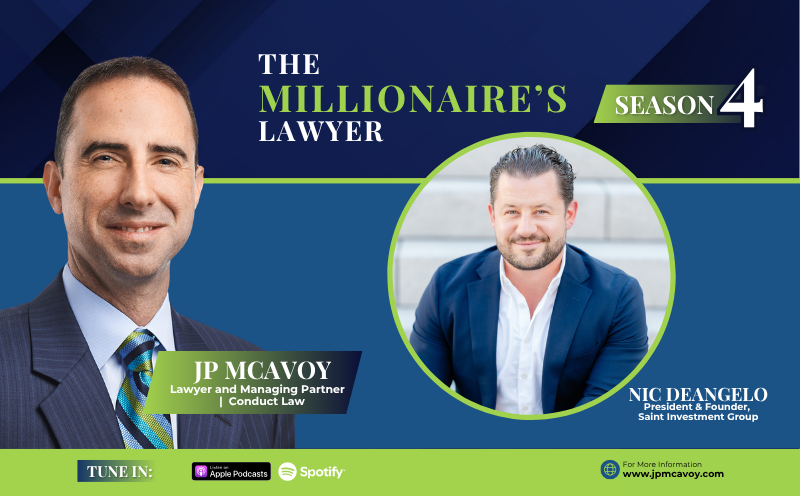
The AI Energy Crisis, Data Centers, and Hard Assets with Nic DeAngelo
“Think about investments over a decade. If it’s something that will weather the storm very likely over the next decade, then it gives you a lot of stability and a lot of benefits, sleeping well at night.” —Nic DeAngelo
Saint Investment Group’s Nic DeAngelo breaks down inflation, real estate, AI, and Bitcoin strategy for long-term wealth building.
AI’s Real Bottleneck Is Energy — and What It Means for Your Money
Everyone’s arguing about which AI model wins. Nic DeAngelo thinks that’s the wrong fight. The real constraint, he argues, isn’t capability — it’s electricity. On this episode of The Millionaire’s Lawyer with host JP McAvoy, the President of Saint Investment Group lays out why the power grid, not the algorithm, will decide how far this AI wave actually goes — and why that reshapes where investors should be looking over the next decade.
AI’s Real Bottleneck Isn’t the Technology
DeAngelo’s team has gone all-in on AI internally, using it to underwrite deals and surface trends across massive datasets. But he argues the real constraint on AI’s growth isn’t capability, it’s energy. Local power grids are already straining under data center demand, and without a serious national conversation about nuclear power and infrastructure, the buildout will stall.
His parting advice, learned from years inside family offices: think in ten-year horizons, not quarterly ones. That mindset shift, more than any single asset pick, is what separates durable wealth from short-term noise.
A Stock Market That’s Quietly Less Diversified
DeAngelo points to a number that should concern any equity investor: the number of publicly traded US companies has dropped over 40% since 1995, and the top 10 S&P 500 companies now account for roughly 75% of the index’s total value. That means the other 490 companies combined make up just a quarter of it. Layer in a CAPE ratio suggesting the market is 30-38% overpriced, and DeAngelo’s caution starts to make sense, even as he remains bullish on the broader US economy.
Real Estate and Bitcoin as Inflation Hedges
While equities raise red flags, DeAngelo is confident in hard assets. Single-family home prices are up roughly 40-47% nationally since the pandemic, driven by a multi-million unit housing shortfall that won’t resolve quickly. He targets markets with genuine supply-demand imbalances rather than chasing headlines. On the crypto side, he keeps it simple: treating it as a liquid, internationally tradable hedge rather than a speculative bet.
Episode Highlights:
03:05 Stock Market Concentration & the Real Estate Outlook
06:22 Inflation and the Fed’s Dual Mandate
11:29 Geopolitics, Oil & Inflation
13:53 Real Estate Strategy: Supply–Demand Imbalances
18:48 The Shrinking Dollar & US Debt
25:35 Bitcoin & Crypto as an Inflation Hedge
28:33 Industrial, AI Data Centers & the Energy Bottleneck
37:04 Think in Decades: Long-Term Investing
Resources:
Get Your Copy of JP’s Book
The Millionaire’s Lawyer: Grow and Sell Your Business for Maximum Profitability
Books
04:04 “What we found is that most other asset classes have settled back into historical norms. We now have a mortgage rate in the United States around that 6% range, which is offensive to us, because we’re used to that 3% for the last decade and a half. But the reality is, if you zoom out 100 years again, it’s roughly 6% average. We’re back to historical norms. The stock market hasn’t adjusted, so that does scare me.” —Nic DeAngelo
05:32 “Real estate is not going away; that’s a component of everything.” —JP McAvoy
11:16 “Rates are higher, whether we like it or not. So plan accordingly.” —JP McAvoy
11:36 “Geopolitics does impact inflation. For every $10 per barrel, oil goes up or down in price, that’s equivalent to 20 basis points of inflation in the United States… The real question is, what do we do about it?” —Nic DeAngelo
16:34 “When inflation exceeds wage growth, quality of life diminishes.” —Nic DeAngelo
19:26 “What we know in the US is that our debt is out of control. It was already out of control, and now we’re in a war that costs a billion a day. We now are also in a position in the US where central banks hold more gold than they hold USD.” —Nic DeAngelo
20:45 “The good news about the US and in our political system is it can bend a lot without breaking, and if it’s running its course as it should, it bends a lot and adjusts in the right direction slowly over time.” —Nic DeAngelo
24:49 “I don’t think that the US is perfect today. The reason that it’s still the reserve currency of the world is that there’s not really a second option. It’s not that the US is so great; the comparative options are just not in the same universe of strength as the US dollar in those ways.” —Nic DeAngelo
27:08 “I see the core strength of crypto being a hedge against inflation, extreme tradability, and extreme liquidity. I think you need those components in your portfolio.” —Nic DeAngelo
31:15 “The best application of AI is taking huge amounts of data, distillation, finding trends, and spot-checking that with human understanding, and with that, we found outcomes fantastic. For the replacement of people, we don’t see that as much. We see more so that the human component is significantly supported by AI, and that we are getting extremely efficient.” —Nic DeAngelo
34:55 “I don’t think there’s enough energy available… We need to have nuclear discussions as adults, and get to a point where there are long-term power solutions, there’s a long-term power strategy. Energy needs to be a top priority moving forward.” —Nic DeAngelo
38:52 “Think about investments over a decade. If it’s something that will weather the storm very likely over the next decade, then it gives you a lot of stability and a lot of benefits, sleeping well at night.” —Nic DeAngelo
A Little Bit About Nic:

For decades, real estate has been one of the most reliable paths to sustainable, long-term wealth. Yet historically, the most lucrative real estate investment opportunities have remained out of reach for everyday investors, concentrated instead among those with substantial capital, specialized market knowledge, and exclusive industry connections.
Nic DeAngelo identified the three core elements that separate top-tier real estate investors from the rest — and built his career around making them available to everyone. Through Saint Investment, he works to democratize real estate investing by leveraging the power of pooled capital, giving everyday investors access to the same time-tested, long-term wealth-building strategies once reserved for the wealthy.
His mission is simple: level the playing field in real estate investing so that anyone who wants to build wealth through proven, long-term strategies has the opportunity to do so.
TRANSCRIPTION:
JP McAvoy: Welcome to the show. Today, we’ve got Nic DeAngelo who’s the president of the Saint Investment Group, and who has spent time in family offices and watching the markets over the years. We’re talking about geopolitical events from AI, to Crypto, to real estate, all the things that the future has for us.
Nic, thanks for joining us here today, from Orange County, I take it. How are things down in Orange County right now?
Nic DeAngelo: JP, things are great. We’re busy. We did get some good weather. We pay for it, but I’m happy, man. The market’s a wild ride, but we’re happy with what’s going on.
JP McAvoy: That’s what we want to see, right? And let’s keep the good times rolling. It’s pretty incredible times, and we think of, we’re talking all-time high in the equities markets working at real estate piling on, we’ve got whole areas, all this cap ex on AI. When’s the crash? When does the party end? It’s just like this could continue with the backdrop of all the geopolitical events that are occurring as well. What is your crystal ball telling you right now? What should we be preparing for?
Nic DeAngelo: JP, I have no crystal ball, but here’s what an amalgamation of all the analysts have to say in a lot of different ways. Number one, I’m pretty vocal about beating up on the US stock market. It’s not that I don’t think there’s amazing companies there. It’s just, if you peel it back to a more historical look and try to put on Uncle Warren Buffett’s glasses a little bit and look at the stock market through something like that, like a real high-level value perspective, then you see the market in a different way. And here’s what we see. Here’s what the data shows us. 1995 was a big year in the US stock market. And since then, what we’ve seen is that the number of companies in the US stock market has declined by over 40%. That on its own is a shocking keep you up at night type statistic. Okay, now, if that wasn’t enough, we have a diversification problem in the market already because it’s 40% less, but we also know that the top 10 companies in the S&P 500 represent approximately 75% of the index’s total market capitalization. So 10 companies out of 500 account for three quarters of the index’s value. The other 490 companies today represent 25% hard stop. Really enough said.
So on that side, it’s no. I’m not shy about the fact that I’m very bullish on real estate. Let me start there. But at the same time, I just don’t see the diversification in the stock market. You can cross-reference that with things like the CAPE ratio, Cost-Adjusted Price to Earnings show somewhere between 30 to 38% overpriced in the stock market. So we went from this, and again, if we zoom out again to look at what this looks like in recent years, what we know is that we had the everything bubble in the US. We printed 80% of every US dollar in history in the last handful of years, and the result was obvious. Everything was overpriced. And now, we’re seeing all the inflation, all the different areas. We hit 9.1% inflation that was supposed to be transitory. No, it wasn’t. We found out later, and where we’re at today is everything has settled back into real ranges of returns that are basically historical, except the stock market.
So where does that leave me with the stock market? A little unsettled. Because what we found is that most other asset classes have settled back into historical norms. We now have a mortgage rate in the United States around 6% range, which is offensive to us because we’re used to that 3% for the last decade and a half. But the reality is, if you zoom out 100 years again, it’s roughly 6% average. We’re back to historical norms. The stock market hasn’t adjusted, so that does scare me. Now, there’s the question of, is that an AI play where there’s just all this extra value that’s just secret and data driven, etcetera? This time it’s different. I don’t know. I think we’ve gotten in trouble historically saying that over and over, but those are the questions that keep me up at night. What’s the future of the stock market? Does it adjust every single other asset class has?
JP McAvoy: It has to, doesn’t it? I think that’s a great synopsis. You talked about this transitory inflation, right, and we suspected that was wrong. It turns out it was right. Seeing the spend on the AI, we’re seeing the CapEx, so we know that there is money being spent. I don’t know how much of it is going to be seen through to completion, I guess is another part of that discussion, but we do see that that is being spent there. The way we talk about transitory inflation, as I put it, I want, one, to have the discussion. The more great people I talk with about this are what we are saying in a year’s time, we knew it was a transitory inflation, we knew it was AI. But trying to drill down on what that actually looks like, obviously, again, real estate, so real estate is not going away. We know that’s a component of everything, and that’s what you do. That’s your day job, we know that. But for the other piece of the equation, where else do you look? What are we going to be seeing in a year? I know there’s no crystal ball, but guessing what that looks like, what are we saying we got wrong in a year?
Nic DeAngelo: I’ll bounce around different kinds of market variables. I focus heavily on the US markets. And at this stage, what I’ll say is this, when we hear Janet Yellen and then Jerome Powell start yelling at the top of their lungs, inflation is transitory. We know, because it’s historical data. We can literally date it. That 9.1% inflation happened 18 months later. I don’t know what your definition of a transitory is, JP, but it sounds like it’s probably close to mine. That sure as hell is not transitory. And now fast forward to today, in the US, our most recent reading, I think, was 3.8% for inflation. The Federal Reserve has a dual mandate in the United States where there’s two things that they are tasked with performing day in and day out. One is the stable currency perspective, that’s a 2% inflation target. The other is stable employment, that’s an unemployment rate right around 4%. We know that a 3.8% inflation reading is way off the charts for what they’re trying to target. On the other end of the spectrum, unemployment, what’s that at? In the US, that’s roughly 4.3%. That’s much closer to the target. Historically, what we know is that when inflation is majorly out of whack, that you raise rates, right? That’s the lever that you pull in that situation.
Historically, like in the 1970s, late 1970s, early 1980s, rates went up to 20 plus percent when inflation was at 10% plus. Today, even though the Federal Reserve, the Federal Open Market Committee, the FOMC has a dozen seats, 14 seats, something like that, the vast majority of those that sit there are hawkish. They are pro focusing on inflation first, and unemployment second. And historically, that does appear to be the right move. The reality is they don’t have the guts or the whatever gusto to actually stand by that decision and raise rates. Again, I’m a real estate guy. Higher rates don’t exactly benefit me to say it’s the right move from a day-to-day perspective, but that appears to be what’s happening. If you wanted me to read one level deeper, I believe there’s political influence that’s playing.
JP McAvoy: Of course. We’ve got that in play as well. Warsh just came in, did things change under his watch?
Nic DeAngelo: I love this deep dive. This is a big question. What’s funny about Warsh is if you look at his background, he has a few things going for him. And I’ll give you three good things about Warsh. One is that Warsh is arguably, I don’t know, maybe not even debatably, the most seasoned to step into the chair role that we’ve ever had in the United States. He’s also an economist by trade, which is a change. Jerome Powell was an attorney, the first attorney we ever had by trade. Warsh does have his JD, but he’s really an economist by trade. Two, he’s the most wealthy. He’s worth somewhere between 100 and 200 million, so the guy’s not a dummy financially. He actually has a lot to lose. He’s invested in the markets. He has a lot of money at stake. Three, he’s good at marrying because his wife is, I think it’s multi billionaire, from, this is more of a joke than anything, but she’s the heiress too, is it like a shampoo brand or something like that.
JP McAvoy: I didn’t know this side. This is interesting.
Nic DeAngelo: So that was a joke. That’s neither here nor there. It’s just kind of funny and an interesting fact.
JP McAvoy: But there’s wealth there. Vast wealth, I guess, is what we’re saying. I think that Powell was not wealthy in his own right, but we’re talking vast wealth, which is a change of perspective.
Nic DeAngelo: Change in perspective, and a lot to lose. There’s this popularity of bringing up the robber barons of the years past in American history, and how we’re back there, blah blah blah. I won’t really over dive in on that. But what’s good about this is that Warsh actually has a lot to lose. And if he’s got a lot of skin in the game, then we want to hope that with a huge background and a lot of money invested, that he would want the markets to play nice. He seems to be hawkish.
JP McAvoy: It’s interesting when you talk because there was all this discussion, there’s political influence, but the first things we’re seeing are, again, hawkish undertones. It’s just interesting, not what we were expecting.
Nic DeAngelo: Especially not what we’re expecting, considering that the preceding comments from Trump were very pro rate cuts. Again, 3.8% inflation. Today, the estimates are north of five in the near future, so this ain’t going the right direction. This is not going in a rate cut direction. And I think Trump, to whatever credit you can give him on this point, he’s laid off the gas of that rate cuts because it’s just a road to nowhere, and he’s got bigger fish to fry in the Middle East and other places, blah blah blah. I think Warsh, if we can pray for any outcome, he does get to be hawkish if he needs to be, and that there’s shackles off. And increasing political pressure we want to attribute to Trump, this is also a Biden era thing, this is also a Trump thing. This has been increasing over several generations of politics in the year.
JP McAvoy: And now it’s macro, in any event. What’s going on in Iran, or what’s happening with oil, it has to be inflationary for what you’re describing. I hear you saying, Nic, as well, that we’re then talking increased rates. That’s the one thing we’ll be saying. As I say, years’ time, we’re going to be saying that rates are higher whether we like it or not, and so plan accordingly.
Nic DeAngelo: And for a while, the Federal Reserve used supply chain issues in the 2000, the early COVID era. They said, well, supply chain, supply chain, it’s not our fault, it’s not our fault. Yes, it was. You printed all that money. But we know that also today, geopolitics does impact inflation. For every $10 a barrel of oil goes up or down in price, that’s equivalent to 20 basis points in inflation for the United States. So we are all tied in. We’re all in the same basket here globally on that side. So the likelihood is upward pressure of inflation. The real question that I walk away with is, what do we do about it? We know that this is likely the weather that we’re sailing into, so what do we do about it? Where do we navigate from here on that? And that’s what we constantly try to crack at Saint as we manage our investment funds, etcetera, on that side.
JP McAvoy: And that’s long term. Again, real estate obviously a component of it, or a piece of what we’re looking to do because they’re not making more real estate. These are things that you can just plot away on, and I think that’s what you guys have done quite effectively. So you put a portion in that, and you get your plan for these higher rates.
Nic DeAngelo: Exactly right. And so on our side, we have an income fund, so our model is evergreen. We are looking 10 plus years in the future. My background was with two small family offices. What I learned from them, the biggest takeaway from these giants, in my opinion, are men that I could not say enough good things about. I stand on the shoulders of perspectives way beyond what I should have had access to at that time. In the wake of 2008 when I kind of made my bones, it was, think decades in the future. These guys thought intergenerationally.
So on our side, we brought that same perspective to our income funds. What we’re trying to do is see around the corner what does a high inflation environment do for the next, maybe, decade of upward pressures, whether they do rates and do different scenarios to tamper that down. What does that do for us on the real estate side? I can speak confidently and say, if you look historically, higher inflation typically, this isn’t a radical saying, it increases the cost of assets, especially hard assets. So you want to be invested in hard assets because those typically will rise with inflation. Real estate’s a good hedge for that. On the other side of that, there are going to be winners and losers. The office still has so many question marks we thought would be resolved by today, and they’re just not. That’s one end of the spectrum. On the other end of the spectrum, which is our darling today, is single family homes in the United States. And it’s not revolutionary. It’s that they printed so much money in the early COVID era, that single family home prices are up 40, 47% across the country.
I get questions on webinars that we host for our investors, and they’re like, well, what happens if home pricing goes down? I’m like, 3%, maybe 5. If we’re talking extremes, we’re still up 40%, ladies and gentlemen. And on that, we still have the largest amount of equity in US history in homes because we’ve been underperforming on home development for a decade here. We’re 4 to 6 million home shortfall in the US. So what we’re looking for are supply demand imbalances in the real estate space. Markets where there’s a need that exceeds the supply, and that’s what we’re investing to today because those needs are not quick. These are years that it takes to catch up on things, like supply of homes in a local market. So that’s where we’re focusing right now. And with inflation on the rise, that actually benefits our position more than anything. We’re not rooting for inflation, but we are losing. Making our position in the midst of the weather, that’s a lot bigger than us.
JP McAvoy: As you see, you can see the weather, right? So it’s the plan just for that. Regions, as you describe this, what regions are you focused on? Where do you think that the largest gains stand to be made?
Nic DeAngelo: So it’s funny, because in the US, sometimes we have a really short-sighted view of markets. Oh, quarterly earnings, quarterly earnings, three months. The last three months looked like this. What we’re seeing is that markets that are overdeveloped but still have good fundamentals, even those markets are weathering the storm really well. So we saw Phoenix, for example, way over developed, something like 20 to 40,000 units, depending on how you calculate that. Way over developed for what their local needs were. But what ended up happening was that it brought down the price of shelter, aka apartments, homes, etcetera. It brought that down, so more people were able to move there, so more businesses moved there, and it’s a business-friendly state. So all of a sudden, you see that balancing out because the fundamentals of that market, pro business, pro growth, etcetera, seem to work out on my side. We do invest nationwide, and it’s really deal by deal basis. We invest in mortgages, so we’re investing in low LTVs, really conservative, stabilized deals on that side backed by single family homes. I still like pro business, pro growth, job growth markets. What I’ll look at as a secret metric, JP, is the local wage, so in the US, we know what wage growth is. It’s roughly 3.6%, right? We know that when inflation exceeds wage growth, quality of life diminishes. It has to.
JP McAvoy: Buying power is down, for sure.
Nic DeAngelo: Buying powers down. Eggs get really expensive when you now know that everything else in your life is getting expensive at a faster rate than your wages are going up. So we’re looking at markets that do have a degree of stability going into the future. So that said, the high-priced markets, the real difficulty to do business in markets, those are tier 2, 3 plus for us, whereas the tier one markets are pro business. We still like our Texases, we still like our Floridas, we still like our Arizonas. I’m in California, not super pro business here. But there are some advantages and some necks of California where there’s still a lot of business.
JP McAvoy: Are you seeing even the exits that we’re hearing? Or is it not as pronounced as it’s otherwise being reported?
Nic DeAngelo: California cheats. I’ll say that kind of little tongue in cheek, that yes. And so California cheats in a few ways. I still like the industry in California because we have two of the biggest ports in the US. We have the Port of Long Beach, Port of Los Angeles imports. If there’s one thing we’ve learned, it’s that, while the rise of manufacturing in the US is so needed in the world that we’re in today, the reality is there’s still massive amounts of imports between the Port of Long Beach, between the Port of LA, any given year it’s in that 30% plus of entire US imports through those two ports. So it’s so condensed that there’s still so much. We’re at a 40 million person state, 60-ish percent of that population is in five counties in the South, you got a lot of people that are entrenched there. My concern, long term, kind of to where you’re speaking to, JP, is what happens when the net contributors to tax start leaving the state at a high rate?
JP McAvoy: And it’s going on now. There are people saying, no, there is too much tax here. As you say, some things are broken or some things that need to be fixed and looked at, and that’s what happens. Even states are competing with each other for those people. They want to be pro-business, they want to attract, and you can make a decision as to whether or not you want to be there. And obviously, California’s got to do something in that, and it seems as well.
Nic DeAngelo: And Texas doesn’t even hide it, man.
JP McAvoy: They’re saying, okay, come over here, then we’ll do it this way here, right? We’ll do it our way here. Again, pros and cons. We can get into a bulk of data, but we’re talking about markets and what’s going to happen. And on that front, you talk about imports. The US dollar, so important from many perspectives. But what do you think? The US dollar, is it going to continue to devalue? What do you think it’s going to look like in a year’s time?
Nic DeAngelo: So there’s an old Warren Buffett quote that makes me want to throw up, but it’s also very applicable to what we’re talking about now. He says the natural course of government is to make the currency worth less over time. And if we think about that in extreme situations, it’s to make it as close to zero as they can because they overspend. So they’re paying back that cheaper debt. What we know in the US is that our debt is out of control. It was already out of control. And now, we’re in a war that costs a billion a day. We are also in a position in the US where central banks hold more gold than they hold USD.
JP McAvoy: That’s new as well, isn’t it?
Nic DeAngelo: That’s very new, and so that’s unsettling. This is a scary trend. The benefit that the US has in all of this, and I’m still very bullish on the US, I’m still very positive of the US as much as I beat up–
JP McAvoy: You’re talking macro, and you’re being realistic here, and you’re being wise as you approach it. Good to be bullish. Obviously, it’s the largest economy in the world.
Nic DeAngelo: That’s the largest economy in the world. I think Americans, at their core, have this ability to really truly figure things out, put their nose to the grindstone and work on it. I’m personally passionate about things like entrepreneurship and investment education, because I think those things are underserved in the US. But when you apply the US economy, when you apply the business force of the United States, when you apply that the US has a democratic society, which is certainly not as unified as China which can make quick snap decisions that last for decades, and they can really plan significantly in the future. Whereas in the US, we have to fight it out every 2, 3, 4 years. The good news about the US and in our political system is it can bend a lot without breaking. And naturally, if it’s running its course as it should, it bends a lot and adjusts in the right direction slowly over time. So I do think that the US will adjust here. My biggest concern is our debt. Whether it’s social, or political, or whatever it is, it’s the debt to me. Because the last presidential election that we had, we had Kamala Harris versus Donald Trump, the debt didn’t even come up in the debates, JP. We’re talking debt out of control, printing 2 trillion a year.
JP McAvoy: There’s no political currency in discussing it, and it wasn’t what it is now as part of the other issue. You can’t ignore it.
Nic DeAngelo: And the problem is the places that we would need to make cuts are things like Medicare, Social Security, defense. We’re in a very hot world right now. We ain’t cutting defense, we’re not seeing that beyond the chopping block. So what does this all do if we speed up the clock? And again, I’m kind of doomed and gloomy about it. But I’ll give a little bit of positivity as a backup. When people feel stressed at home, they have less kids. That’s not revolutionary, right? What we know in the US is our fertility rate, aka the average amount of kids that the average female has is roughly in that one point, I think it’s 1.6, 1.62 in the United States. Replacement is 2.1. So what that means is if we want to keep up our population, there’s a mandatory inclusion of some kind of immigration strategy. And in the US, the two things that we’ve seen politicians immediately not ever want to solve are the debt crisis and the immigration crisis.
So those two things, I think, it’s whichever party can lean into those and actually soberly have real discussions on how to solve those issues on the debt side, really meaningfully cut debt or cap debt and do that over a long period of time, and then to have a meaningful immigration policy. Canada has a fantastic points-based, merit-based system where they look at all kinds of factors, and determine where people should be immigrating from? What will their future culture look like? These are smart perspectives on immigration. In the US, we just don’t have that. We’re not able to have those discussions if we solve those two. I think things like inflation and things like long-term perspective get worked out naturally. Those are my best.
JP McAvoy: Certainly, you’re right because it alleviates a lot of those pressures. That being said, I think it’s a lofty goal. I know what you just described, the politicians know them. At least the smart ones know themselves as well, but they can’t get elected. And those others that are voting for them are not willing to vote for people looking to fix those problems. Let’s park those on the side. Because as I say, those are big ones that I don’t know if we’re going to resolve, but they do impact the dollar. We haven’t really drilled on what we think the dollar is going to look like. Because part of what you just described as well, part of it could be solved by devaluing the dollar, and there’s a lot of people saying that that’s what’s occurring as well.
Nic DeAngelo: I couldn’t agree more. I think it’s a systematic devaluation of the dollar. I think it’s a strategic debt-based decision to devalue the dollar again. We lightly touched it. But if you take $1 today and look at $1 in 1913, $100 today is $1 in 1913, right? So the dollar has been devalued. And since 1971 when we got off the gold standard, the vast majority of that occurred. So now, we’re in true fiat Wonderland here where the value of the dollar is determined by how much is in circulation, and we’re pumping those numbers up every year. So my bet on the dollar to kind of put it on the nose with exactly what you’re asking, I see more of the same. Unfortunately, I see more of the same.
JP McAvoy: It’s a gradual bleed, though, you’re not gonna be a correction then, or there won’t be something where people just decide to move away from the dollar.
Nic DeAngelo: Well, we’ve seen that gold has already moved away, and that central banks have already moved away from the dollar as their dollar versus gold holdings. But here’s what I’ll say, I don’t think that the US is perfect today. The reason that it’s still the reserve currency of the world, I think it’s there’s not really a second option if you really drill down. It’s not that the US is so great, the comparative options are just not in the same universe of strength as the US dollar. In those ways, you could talk about the euro, just no. And again, I have a lot of family in the European Union. DeAngelo is not a native American last name. We came through Ellis Island like everybody else during that era, and the euro is just not going to step up. It’s just not a possibility. It’s 27 different member states, different bond structures. It doesn’t have a unified bond structure like the US has.
JP McAvoy: Yeah. I don’t think it’s not that sort of power that you need to be a hegemony area. There’s some discussion that things are gonna be repriced? And they’re trying to do some oil and one right now, but I don’t know if that occurs either. I know you’re not a big crypto guy. Have you ever put your mind to, or thought of how well, among other things, stable coins are being used? How are they being backed by US debt?
Nic DeAngelo: So crypto is one that is very interesting to me, and I think the technology behind crypto unquestionably has applications even beyond crypto that is game-changing, world-changing, finance-changing in a major way. On my side, here’s what I’ll say, because there’s so much nuance and so much depth to the crypto space, I’m really boring and I stick to the winners. You know what I mean? And in my mind, Bitcoin is that winner. My average holding in Bitcoin was an entry point of roughly 20 to 28,000.
JP McAvoy: Do you consider that to be a hedge against inflation then as well?
Nic DeAngelo: 100%. And the reason gold is great, and if you zoom out thousands of years, gold was the reserve currency of the world at so many different phases. But what’s the practical application of gold, JP? You want your life savings in gold. Are you going to throw it over your back, walk around and trade gold? No, not really. And what I like about crypto is it really truly has the ability to trade internationally in a very real way, quickly, efficiently, safely today. And all those things being the case, I like crypto for those reasons. There’s a lot of chaos with things like the crap coins and other parts of crypto, but I really don’t see those as core strength of crypto. I see the core strength of crypto being hedged against inflation, extreme tradability, extreme liquidity, and I think you need those components in your portfolio. And so for that reason, yeah, I hold Bitcoin 100% exclusively. I’m not really diving into other areas, but the stable coins are a little outside of my purview. But what I’ll say is that it’s getting very interesting what I’m reading and slowly catching up on there. I think the strategies, governmental level strategies to have stable coins built into a system, I don’t have any idea of a crystal ball on that one, though.
JP McAvoy: Yeah, and I mean it’s a question of being of watching, right? Because we’re getting some regulatory clarity now, practically the very Clarity Act, or it’s just we’ve already got the Genius Act, the Clarity Act. Looks like we’re going to see it through. I think the banks need to be aware, right? They are, they’re fighting for their territory, but from what you’re just describing, I think you’re quite right. There’s another set of rails. There’s another way, right? There’s cryptocurrency and Bitcoin being the, you know, the granddaddy of them all. They’re only making like, like land, only so much Bitcoin as well, right? So we know we’ve got 21 million people parking up a part of their portfolio in that as well, right? We talked to real estate, we’re questioning equities, looking at what equities look like, and of course, we got parked a little bit in Bitcoin as well. Any other area you look to?
Nic DeAngelo: Yeah. In the investment side, right now, I do have my eye, I’m super partial towards industrial. I do think that the upside for the future of the US markets, especially, and really globally, I think a lot of it is going to be leaning on industrial AI data centers, whether it’s manufacturing, and that getting less global and more regional. Whether you’re talking about the really heavy industrial rare earth metals being divested away from China, I think the future of the world is going to be looking a lot more industrial on that side across the board. And frankly, I think we have a national security problem in North America by not having more manufacturing in the North American neck of the woods. So for all those reasons, I really am pro industrial. I think that will really, really be a future for the next 10 plus years. I have my eye on AI. Probably like everybody else, I’m 50% holding my breath, and 50% expecting a revolution of change across business. And so I have a big eye on AI.
JP McAvoy: When you say an eye on AI, what do you mean? We’re all watching, and hopefully participating. We’re spending some time on this show making sure people are aware. It’s hard to go without seeing the beginning of the impact this has and starting to imagine how great that impact is going to be. As you say, keep your eye on it. What are some things you’re looking for?
Nic DeAngelo: Yeah. Maybe I underplayed that a little bit. We’re extremely involved in it. When we say keep an eye on it, what I really mean by that little tongue in cheek is we’ve dove in dramatically on AI. And really, on our side, everything’s about data. We want to know who’s used it, what they did, what the outcome was, and what that looked like. What you see is this, it almost seems like the tale of two cities. Things are so far apart that they can’t exist in the same universe. But alas, they do. What we’ve seen is you have the MIT study that anybody that hates AI is going to point their finger at and say that 85% of companies that applied AI found significant reduction in performance. You look into that study and you squeeze it down a few more layers, what you find is that the application was garbage. And that employees pushed back, and there wasn’t a clear reason why they were doing it. There was no leadership that owned it.
And what we’re actually seeing on boots on the ground, on our side, competitors, the real estate space, the investment space, AI is revolutionary, but it’s not replacing jobs in the same way that the fear mongers are saying. What we’re finding is that the application of AI saves infinite hours, and it saves infinite spot checks, and it saves huge amounts of these deep dives on data that’s so dense. And what we found is that the best in our instance and many of the investment world’s instances, the best application of AI is taking huge amounts of data, distillation, finding trends, and spot checking that with human understanding. And with that, we found outcomes fantastic. That is automation that’s already been proven for AI. That case study is already stamped for the replacement of people. We don’t see that as much. We see more so that the human component is significantly supported by AI, and that we are getting extremely efficient. We underwrite hundreds of deals at a time. We have constant deals out in the real estate space. That is much more efficient. Let’s say it’s a tier two market that we don’t have huge exposure to. We can catch up in minutes instead of days. And then a human element overlooks that, or oversees that, and catches up on that. So I’m extremely optimistic about that.
I’m extremely pro AI on that. And the bigger wrestling match that I have mentally on that is it’s us versus China, if you want to think of it that way. That’s the headlines that you know it’s being proposed as kind of the rumble in the jungle of the AI war. But the reality is I actually do believe that we need to be on top on AI. I think North American AI needs to be up there. I think that we’re starting to see the NIMBYism of local politics where it’s like, Not In My Back Yard. We don’t want these data centers here. And then again, back to the industrial component. How the hell do we have the energy for this? There’s a fundamental miscue, miscalculation of how much AI we need and how much processing power we need with how much energy we can actually perform on. It’s nice to say that the United States and North America are energy independent, and we have enough oil that still doesn’t get us to the–
JP McAvoy: It’s nowhere near what we’re being told right now. If we’re listening to the experts in these areas, there’s nowhere near the power required to run the AI. Now, the AI needs are only going to increase, that’s why I’m sold as well. Obviously, we spend time here talking a great deal on AI and on the show itself, and for those that aren’t embracing it, they’re going to be left behind. The people that are using it, as they may not lose their job, but the people are using it effectively, the ones that are going to outperform so you need to be there, you need to be using it. When we’re talking about power, I guess, maybe there’s some opportunity there. When we talk about the equities, because there’s that mispricing, we don’t have all the AI power available to us, and so we’re going outside of the grid. We’re getting companies looking to nuclear, certainly gas producers. You got none of them trying to actually go straight to the data center, right? They’re trying to go, they’re trying to provide the power straight to where it’s required, as opposed to going through the grid, which itself needs to be updated. So if we’re looking again in a year or two from now, how many of these data centers, I mean, I know, again, not your area of expertise, but you’re good looking at real estate. How many of these data centers are going to be built? How much is this actually going to come to fruition?
Nic DeAngelo: Again, a little outside of my confidence circle, but what I’ll say is, this is that the vast majority that I don’t think happen and I think there’s three reasons for it. One is going to be NIMBYism, the “not in my backyard” aspect. And to be clear, this has been brutal for a lot of communities in the United States. People in rural Indiana, I think is the most recent study, their local electricity bills went up to like 800 to 900 bucks a month. You’re talking 100 bucks a month, 200 bucks max. You saw a 4 plus x increase in electricity, they are subsidizing that local infrastructure, they’re subsidizing what that looks like on our side. And that’s number one. Number two is I don’t think there’s enough energy available. You said it, you said where my head’s at, that at some point we need to have the nuclear discussion as adults and get to a point where there’s long-term power solutions, there’s long-term power strategy, and that electricity, energy needs to be a top priority moving forward. And we know that from the Strait of Hormuz, that when 20% of the energy in the world and the oil world is constrained, the whole world feels that we need to get away from that.
And then there is, I think the technology and the chip manufacturing, etcetera. We need to get back to having a better control of that. We have conversations that China takes over Taiwan, and it’s screwed for everybody. And China has a monopoly on it. Between those three things, it’s a really unsettling perspective and a projection on that. What I’ll say is we make the designs for the highest level chips in the United States, so it’s North American based. I think that’s pretty damn good as far as energy. We’re energy independent. I think that’s pretty damn good. I think we have some political movement to get over some of the nuclear power questions, and I think we can get there. And number three, NIMBYism. At some point, there needs to be a bigger ownership and a bigger push at a larger level with governments to be getting these things done, knowing that this is national security and long-term perspective and economic outlook that we need to do it where it needs to be on that side and support communities to be able to do that. If those three things are solved, I think we have a very blue sky future on that, and we will beat China and be the AI leader on that side. If not and we falter on those, then it gets a little funky.
JP McAvoy: It gets a little funky. I think you’re quite right. I think that we do get there. Obviously huge issues that need to be resolved, but we’re working on them. And I think we’re going in the right direction, that much is clear. This is such a helpful discussion. I think those listening as well will agree. We’re talking of the future, trying to map what that looks like. We know how important AI is. We know that cryptocurrencies are coming, and we always know that you have to keep some powder dry, and maybe keep some traditional investments as well to help the whole portfolio move along. Nic, it’s been great talking with you with all these discussion points here today. If somebody was interested in digging a little further, in particular on the real estate side of things, how do they get in touch with you?
Nic DeAngelo: The absolute best thing that we can offer for anyone, if somebody really enjoyed a discussion like this, this is a niche discussion, JP. We actually have a book that we just released called Economics Over Politics, that takes the biggest economic trends in the United States that are not being covered in the news. We’re digging into the real wheels turning in the housing market, inflation, etcetera. And then also how to invest through those. We have an entire book on it, 220 pages, Economics Over Politics. They can get more information on that at saintinvestment.com/book. I highly recommend it. We’re the best seller in three categories for economics, so it’s a great book, and it really deep dives on these topics.
JP McAvoy: Fantastic, thanks for that. Anyone listening, do go grab that, and we’ll have everything in the show notes there as well. Nic, you’ve obviously dug in deep. A lot of a wealth of topics as they come together to form what the future for us looks like. I like to end these episodes with one thing or something you’ve heard along the way that’s really informed you and really led to your own success. Something that maybe somebody here listening to, if they hear it, will apply in their own life and take them to the next kind of stock. You did some incredible things at the family offices, you’ve built your own business from here. What could you say to somebody listening that something they could do for themselves to move themselves forward in the next year or five years?
Nic DeAngelo: Number one thing that I can give advice on, and again, it does come from the family offices. This isn’t even directly from me. Thinking about investments on a 10 year horizon gives you the stability over the long term to both be amazing at what you’re doing today, and also have stability over the long term. You consistently see the best performers do that. We do that at Saint. If there’s one piece of investment advice that I would suggest people consider, it’s, think about investments over a decade. If it’s something that will weather the storm very likely over the next decade, then it gives you a lot of stability and a lot of benefits sleeping well at night.
JP McAvoy: That’s great stuff. Thanks so much, Nic. We loved having you on the show. We look forward to next time on The Millionaire’s Lawyer.
Nic DeAngelo: JP, I had a blast, man. I look forward to talking to you again soon.
Recent Comments