
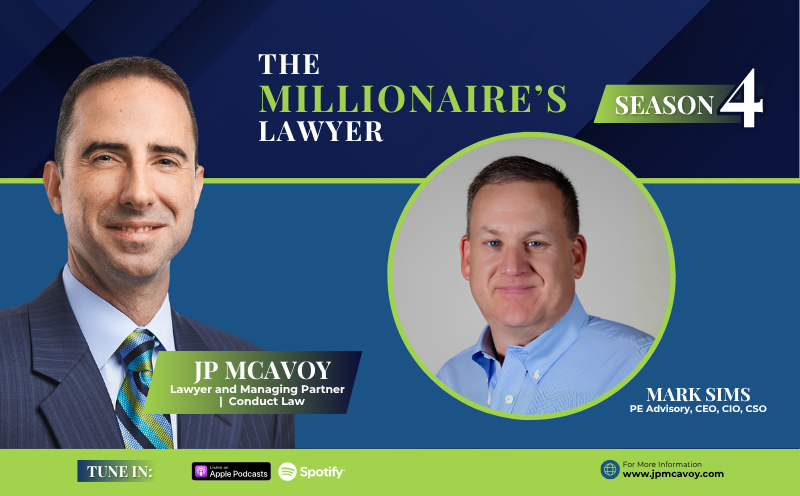
AI Force Multiplier Trap: Why Bad Data Kills Most AI Projects with Mark Sims
“If the tool is subpar, but the process and the people are there, you can make it work. If the tool is exceptional, but the people and the process are suboptimal, you’re probably going to have a failure on your hands. Make sure that you’re layering any type of technology on top of a solid foundation.” —Mark Sims
Most AI projects fail because of bad data, not bad tools. Mark Sims, Fortune 1000 CIO advisor, explains how to build the foundation AI actually needs.
Why Bad Data Is the Real Reason Your AI Strategy Fails
The AI force multiplier every business owner is chasing — doing more, faster, with less — is real. But most companies never reach it. Not because they chose the wrong AI tool. Because they skipped the unglamorous step that makes AI useful in the first place: building a single, trustworthy data foundation.
That’s the core argument Mark Sims makes in this episode of The Millionaire’s Lawyer. Sims is a business transformation and M&A strategy executive with over 25 years of experience — he’s held CEO and CIO roles across Consumer Products, Retail, Manufacturing, and Private Equity, and completed the Advanced Management Program at The Wharton School. When he says most AI initiatives fail before they start, he’s speaking from dozens of enterprise transformations, not theory.
The Data Problem That’s Quietly Killing AI Projects
Here’s a simple test Sims recommends. Ask your sales team what last month’s revenue was. Then ask your finance team the same question. You’ll get two different numbers — and both will be technically correct.
Sales counts gross revenue. Finance subtracts commissions and trade dollars. Neither team is wrong. But when an executive walks into a meeting, and the numbers don’t match what they saw last time, trust collapses — in the data, in the reports, and eventually in any AI system built on top of that same data.
This is what Sims calls the absence of “one version of the truth.” It’s not a technology problem. It’s a process and accountability problem: who can pull reports, how those reports are labeled, and whether people are entering data correctly in the first place.
No AI model fixes bad inputs. As JP McAvoy puts it directly in the episode: “If it’s not a good input, you’re not going to see a good output.”
The fix isn’t glamorous; it’s governance — defining data ownership, standardizing reporting logic, and holding teams accountable for clean entry before any AI layer gets added.
Where AI Is Actually Delivering ROI Right Now
Once the foundation is solid, Sims points to three areas where AI is producing real, measurable results today:
- Legacy code refactoring. Decades-old codebases that would take developer teams months to untangle can be accelerated significantly with AI assistance — one of the clearest productivity wins in enterprise tech right now.
- Ad and marketing multiplication for small businesses. A small business that can afford two creative concepts can use AI to generate ten variations and A/B test them — matching output that previously required an agency budget. Sims frames this not as replacing creativity but as multiplying it.
- AI voice agents in customer outreach. Sims shares a counterintuitive finding: AI voice agents that openly identified themselves as AI outperformed agents scripted to sound human. Transparency, in this case, was a competitive advantage.
Against these wins, Sims cites sobering research from Harvard Business School and MIT showing that most AI projects still fail to produce positive ROI. The gap between AI headlines and AI results remains wide — and it’s almost always a data and process problem, not a model problem.
The AI Governance Policy Your Business Is Probably Missing
The practical step most business owners are skipping: a written AI usage policy.
Before your team uploads another document into ChatGPT or Claude, you need to know:
- What categories of data are employees permitted to share with AI tools?
- Does your subscription tier train on user inputs — and if so, is sensitive company data being used to improve a public model?
- Who is accountable for enforcing these boundaries?
Sims compares this to the IT usage policies companies took seriously a decade ago — the same principles apply, updated for the current toolset. Businesses that treat AI governance as an afterthought are leaving a door open to data exposure they may not even know is happening.
The companies that win with AI long-term, Sims argues, won’t be the ones that adopted the flashiest tools first. They’ll be the ones that built the right foundation — clean data, clear process, and a governance policy that traveled ahead of the technology.
As Sims puts it: “If the tool is subpar but the process and the people are there, you can make it work. If the tool is exceptional but the people and the process are suboptimal, you’re probably going to have a failure on your hands.”
Ready to separate AI hype from AI that actually moves the needle? Listen to the full conversation with Mark Sims on The Millionaire’s Lawyer at www.jpmcavoy.com/podcast.
Episode Highlights:
01:24 The AI Promise vs The AI Reality Check
03:47 Your Data Is Lying: The “One Truth” Problem
11:09 Where AI Is Actually Winning Right Now
14:08 Why Admitting You’re AI Outperformed Faking Human
19:46 The Infrastructure AI Needs That Nobody’s Building
26:10 Writing the AI Policy Your Business Is Missing
32:44 ERP Systems: The Hidden AI Bottleneck
35:34 The Non-Negotiable Foundation Under Every AI Win
Resources:
Get Your Copy of JP’s Book
The Millionaire’s Lawyer: Grow and Sell Your Business for Maximum Profitability
Books
The Economics Over Politics “Hidden Chapter” Vault | Saint Investment
Quotes:
04:30 “It all comes from good data. If it’s not a good input, you’re not going to see a good output.” —JP McAvoy
05:36 “What do people need to do to build a good foundation? Part of it is making sure you have the process, discipline, and you’re holding people accountable, that they’re recording all the transactions correctly in a timely fashion— that starts to build that foundation.” —Mark Sims
09:15 “Having good data governance is key, because ultimately, why do you want the data? —You want to be able to make decisions.” —Mark Sims
22:31 “We are being empowered by AI, and it’s interesting to see how Wall Street’s responding, and how it’s impacting valuations as well. The markets continue to hit all-time highs, in light of vast geopolitical challenges.” —JP McAvoy
32:29 “ The other thing that people should look at is if you’re on a very outdated ERP system, or work for a company that’s not releasing new updates, something that you could think about in the next two to three years is how to migrate to a more modern core system that has an owner that’s going to be investing in AI tools.” —Mark Sims
37:37 “If the tool is subpar, but the process and the people are there, you can make it work. If the tool is exceptional, but the people and the process are suboptimal, you’re probably going to have a failure on your hands. Make sure that you’re layering any type of technology on top of a solid foundation.” —Mark Sims
A Little Bit About Mark:

Mark Sims is a business transformation and M&A strategy executive with over 25 years of experience leading enterprise growth initiatives, ERP implementations, and technology transformations for Fortune 1000 corporations and boutique advisory firms. Across roles as CEO, CIO, and Head of Strategy in Consumer Products, Retail, Specialty Packaging, Manufacturing, and Private Equity, he has built a track record of turning complex M&A transactions and legacy systems into clear, measurable business value.
He holds a bachelor’s degree in Industrial Engineering from the University of Michigan, a master’s in Industrial Engineering from Cleveland State University, and completed the Advanced Management Program at The Wharton School.
Mark’s career spans leading transformative IT strategy at Scotts Miracle-Gro to scaling M&A operations and guiding RIV Capital’s transition into a high-growth buyout firm. He works at the intersection of strategy, technology, and execution — shaping corporate strategy, navigating M&A complexity, and developing the next generation of IT leaders. His focus never wavers: create real value and drive change that lasts.
TRANSCRIPTION:
Welcome to The Millionaire’s Lawyer where you’ll hear leading professionals share expert advice on how to grow your business and sell it for maximum profitability. If you want to learn lawyer proven strategies for building and exiting your business, then this is the podcast for you. Your host, JP McAvoy, is a Business Lawyer, College Professor, and Best-Selling Author who has been assisting clients start, grow and sell their businesses for millions of dollars for over 15 years. Will yours be the next? Now here’s your host, JP McAvoy.
JP McAvoy: Hi, and welcome to the show. Today, we’ve got Mark Sims, who has been a CEO and CIO of various corporations and assisted in the transformation and growth initiatives for Fortune 100 corporations. Here’s my conversation with Mark Sims.
Mark, thanks for joining us here today from Cleveland, Ohio. How are things looking in Cleveland these days?
Mark Sims: Everything is good in Cleveland. On our end, we’ve got a bright, beautiful, sunny day, although a little chilly. We got a taste of summer last weekend in the high 80s. And now, we’re back into the 50s. Welcome to the Midwest.
JP McAvoy: That’s right, that’s just the way it runs. And business these days, how are things looking on the business front?
Mark Sims: Things are actually going really well. We’re seeing a lot of deal activity, that’s primarily where we kind of work a lot, primarily exposed to private equity clients and their firms. We like to say we help companies transact, transition, and transform. The transact side, obviously, we do M&A advisory due diligence on the IT side, the finance side, the human capital side, so seeing a lot of activity there. The transition is more stepping in as management as teams as they close the deals and figure out what resources are needed. And then the transform piece is where I spend a lot of my time, which is really on the technology front. Now that you own the company, either an established business or a PE firm’s just acquired it, how do we actually transform the business to be more efficient and effective?
JP McAvoy: And I’m sure that provides a lot of the opportunity, right? Or why the decisions were made to get involved originally. How much is AI affecting the way that the work is being done now? As you come in and start to have a look at the way the companies are actually operating.
Mark Sims: Sure. I’ll use kind of the same framework of transact, transition, and transform. I think on the transact side, we’re seeing more and more demand from the PE firms to figure out how they can leverage AI to complete diligence quicker, more efficiently, and analyze more data. A lot of times, some of these mid-market companies don’t have the data, so that can be a bit of a stumbling block. But definitely being able to prepare analysis reports, due diligence reports, and just wade through all the information that typically has to get loaded into a data room, people are looking at how to leverage AI to do that efficiently.
And when you think about AI, there’s frameworks out there that talk about, you know, if you’re looking at words, images, numbers, or sounds, that’s a great use case, as I’m sure your listeners know. So that’s a key area there. And the portfolio or the PE firms are really looking to also use AI on the front of, how do we find the next deal? So they get 2000, 3000 sims per year. How do we wade through all this and find where the really interesting opportunities are? So that’s on that transaction side. On the transform side, that’s where we have a lot of discussions with clients, and they want to figure out where to jump in. And a lot of times, quite frankly, we spend a lot of time building that foundation. Maybe some interesting use cases, but if they wanted to do something novel and specific to their firm, they don’t really have the data available, or structured in a way, or assembled in the way, I should say, that they could actually leverage the data. A lot of times where we have to start is really focused on the fundamentals of getting the core ERP system to have good, clean data, focus on a basic analytics solution that has one version of the truth, and then you can layer the AI on top of that.
JP McAvoy: That’s interesting. A good foundation. Let’s drill down on that. Because as you say, good data. And it all comes from good data, I suppose. If it’s not a good input, you’re not going to see a good output. But for those listening, when we talk about actually laying a good foundation. What are some of the ways that you would coach or suggest that people do or lay the proper foundation?
Mark Sims: A lot of times, we go into companies and they have an ERP system. It could be QuickBooks, it could be SAP, You can span the gamut. A lot of times, the data challenges exist because people aren’t being held accountable for entering the data appropriately into the system. A lot of times, people say, hey, we need to replace our ERP system. It’s not working for us. But then, when we actually do an assessment, we take a look and say, well, this system is fine for what you need to do. It’s going to meet your capabilities. You’re just not using it effectively. Sometimes, maybe it wasn’t configured properly. The business has evolved, and it no longer meets the needs of the business. You need to make some changes. But a lot of times, it’s lack of process discipline. When you talk about what people need to do to build a good foundation, part of it is making sure you have the process discipline. You’re holding people accountable, that they’re recording all the transactions correctly in a timely fashion, and that starts to build that foundation. If there’s master data cleanup that has to happen, again, all this stuff seems really uninteresting, but it’s so fundamental. Because ultimately, I see it in businesses. $25 million, $10 million business, all the way up to multi billion dollar businesses, everybody struggles with this data issue where they don’t have a clean single source of truth. And even if they think they do, you can always find people in the finance department typically that are saying, yeah, I don’t fully trust it before, for a variety of reasons. So as much as you can have that people and process discipline, the system will record whatever you put in there, and then you can get that out the back end.
JP McAvoy: So when you say that source of truth, it’s something you can rely upon, obviously. What do you mean? How do you make it as trustworthy as you possibly can? How do you get your best data set?
Mark Sims: I think one thing that listeners may be saying, what does that mean? One version of the truth. A great experiment in your company would be to ask someone in finance, ask someone in sales, and say, tell me what sales for the month of April were? And you’re going to get two spreadsheets, two PowerPoint slides, whatever it might be. And typically, what we see is those are different numbers, they’re both correct. Because you’re going to talk to the salesperson, they’re going to say, well, this is everything, all the revenue, gross revenue, basically. Yes, the finance people, they’ll say, this is gross revenue, less commissions, less trade dollars, whatever it might be. And so they’re both correct. But if you’re an executive trying to make a decision and you’re in a meeting, you’re seeing these numbers and you’re like, that doesn’t match what I saw in the last meeting. Now, you let the numbers lack trust. I think part of what I’ve done in the past is when you have a core data set that represents sales, for example, making sure everyone’s educated on how to pull the data, maybe limiting who can create reports. I’ve had that issue at companies in the past where the so-called super user concept sounded great, like everybody can generate their own reports. The challenge is people generate those reports in different ways with different filters. They name them the same things. And then two years later, when someone’s pulling it, they don’t really know what that data represents. I think another thing that might sound fancy in data governance, but part of it is just really around making sure that you understand what the numbers are, what do the numbers represent? Who has the ability to pull the numbers? And when they do, are they footnoting them properly? Or ascribing the right definitions around them to say, what does this number actually represent?
JP McAvoy: And this is universally true. This is not something that is new at all. It’s been a challenge for business for decades, from the beginning as new systems come.
Mark Sims: And it discriminates in terms of companies, large and small. And sometimes, obviously, when you think about a large company, the issue can get multiplied. Because now, you have multiple countries, billions of dollars of scale, lots of people touching the data. And so having good data governance along that spectrum is going to be key. Because ultimately, why do you want the data? You want to be able to make decisions.
JP McAvoy: Yeah. It needs to be useful. As we said, as I said earlier, good input, good output. It’s so important to make business decisions based on the best possible data. So it’s interesting, you’ve been doing this for some time now to see how things have evolved. Again, we focus so much now in AI, and we try to focus the show on this just as well. You talked generally speaking about how you’re seeing it across different clients. You just broke down the application sales versus the finance team, how are you practically seeing them actually using AI?
Mark Sims: Yeah, sure. Again, as I mentioned earlier, a lot of companies, they don’t really have the single source of truth that they can layer on top of, say a credit management app where they say, here’s all the credit approval data with really deep information, and we’re going to put a large language model on top of it so that we can automate credit approvals. A lot of times, that data is just not clean enough. It’s going to give it inconsistent results. Not that they shouldn’t look at those use cases. But a lot of times, they can be challenging, especially for some of the mid-market companies that maybe lack resources to do that internally. If you need to bring in outside resources, that can be expensive. But what I always encourage clients to do is actually start using these tools. And this could be as simple as using ChatGPT, Claude, whatever that might be to figure out how I can produce more effective marketing copy? How can I generate some more interesting ads? If today I had two online ads I was going to run, maybe I could run five because I can generate different content. I can do some A/B testing to see which is the most effective. Using that in kind of the knowledge work areas to augment and accelerate what people are trying to do. The one thing that we talk about is, how can you use AI in that concept as a force multiplier? So if you are a small business, you don’t have the ability to hire an agency to help you design all these novel unique ad campaigns, that’s a great use case for AI because it can generate lots of ideas very quickly that you can then have someone screen, you can test, you can do all those things. So how do you get that force multiplication using AI? And obviously, that’s just using generative AI as these agents evolve. And again, I think they’re still in their infancy. But as they evolve, I think that’s really going to be another force multiplier for people to think about how they leverage.
JP McAvoy: Have you seen any of these agents? Have you seen anybody using agents at any scale at this point?
Mark Sims: I have not. We’re seeing agents, and it kind of pivots into where I’ve seen some current clients where they’re doing some interesting novel things with AI outside of the generative AI sphere in the code refactoring space. So being able to leverage agents to analyze existing legacy code that may be on older versions of visual basic, or whatever it might be, access databases and how do we now refactor that into a more modern solution? I think that’s a great use case for AI. There are agents that use those processes. But I think we’re just at the beginning stages of thinking through how people can leverage the AI tools of that refactoring code generation, I think, is one. Another really interesting use case is looking at specific spaces where a human used to have to go in and estimate what refurbishments were needed for a given property. We’ve seen some interesting use cases where people are just taking photos, and then the AI can actually generate and say, okay, looks like you’re going to need some drywall work, you’re going to need paint, you’re going to need new windows, whatever it might be.
But the AI tool is not only figuring that out, but then also building that work plan that somebody can execute. Obviously, a next step from that would be, how do we start to take that and automatically start scheduling those services? That’s the next chapter in that space. Another one that I saw recently for a board that I sit on, not disclosing anything proprietary, but they’re actually using AI chat bots to place calls to new customers to welcome them. And they get thousands of customers, new customers each month that used to represent a lot of agents’ time where they have to do that. So they’re actually leveraging some AI tools to be able to do the welcome, make sure there’s no questions from the new member, and give a personal touch. They’re doing it via phone calls, but also can start to look at using texting as well. So really, I think people, as I mentioned before, that words, images, numbers and sounds, which sounds being the voice piece, I think all of that is really interesting use cases you can think of given your specific environment.
JP McAvoy: That’s such a great answer, Mark, to my question. We’re spending a lot of time thinking of what the future is going to look like on this and many other points. But certainly, AI, as you said, it’s early. You just gave three or four great examples of how you’re seeing it deployed to some effect. Obviously, I’d like to just hone in on the last one to the extent you’re comfortable talking, because I appreciate it’s in a broad capacity. The findings are from what you’re understanding of the findings that the AI, the sort of welcome, is being received in a way that is giving comfort to move forward with it. Because I’m just wondering, how much is that gonna occur? It’s actually working. Can you talk to that a little?
Mark Sims: And again, there’s another client that we have that we weren’t involved with. They kind of did it in house, which I think speaks to the ease with which you can implement some of these tools. But they were using similar outbound calls for the long tail. So customers that had previously purchased from you, but you haven’t heard from him in two years or whatever it might be, and just reached out to say, hey, would you be open to an actual sales call? And I’m looking to schedule time with you. Your regional rep, your district rep, or whatever it might be. I think in both cases, what I’ve heard, or what the statistics bore out is they were effective. And definitely were effective from a traction perspective with the customer. They were also effective from a cost effectiveness perspective. When you think about the amount of time that you’d have to pay a resource to do that job to make those calls, a lot of which are going to be no answers, or quick hang-ups. A lot of that needs to be worked on, but I think they’ve both seen good success.
JP McAvoy: There’s success there. And obviously, you make the argument from a cost perspective. It’s just how it’s being received. I know, for me, let me just ask you, personally speaking, because as I receive more and more of these types of calls, I don’t even answer the phone. I know a lot of people don’t answer the phone anymore. There’s been some, obviously, just great cases. I think maybe part of the reason why they are effective is that these are, as you say, to follow up for somebody that two years hasn’t been in touch. It’s something that they welcomed two years previously, and they’re like, I was just thinking that myself, or I wanted to get engaged, or something on that end of things. Which is perhaps a little more lukewarm. But like for yourself, if you receive that type of call, do you still answer your phone?
Mark Sims: I absolutely answer my phone. Do I answer potential spam when it pops up? No. One thing I will state is that the AI doesn’t make the numbers, it doesn’t make people answer. So when we actually think about the company that was looking at the long tail of their customer base, they still had a very low connect rate that would be expected if people are going to pick up. But once they got the connection again, it’s connections that they wouldn’t otherwise have made because they wouldn’t have prioritized the time. And so part of it is thinking through, how do I take an asset, which is a customer who had purchased from me previously. How do I potentially tap into that asset in a cost-effective way? So that’s really the use case I see. The interesting thing too, I know one client that I’m thinking of, they actually tested it both ways. So they tried to say, oh, this is just Mark calling, but you can kind of detect it. They’re not that good. And those didn’t perform as well as when you were up front when it said, I’m an AI agent. But here’s what I’m trying to do, try to see if you’re interested in a reconnect phone call with your district manager to see if you have any needs that we could be helpful for.
JP McAvoy: And that was a better response, which is interesting. That’s not kind of lukewarm saying, okay, I was thinking, anyways, it saves me having to look up the number and call. I wouldn’t mind talking to someone, actually, let’s set that up.
Mark Sims: Again, I don’t know that. I think their stats showed that it was as effective when they’ve run these campaigns previously with human agents kicking in. I think that’s the reality of it. You’re replacing, but the way I think about it, again, that force multiplier concept that I mentioned earlier, it’s work that probably wouldn’t ordinarily get done.
JP McAvoy: Yeah, for sure. I’m leading the question into this idea. How are things changing? As you say, that’s something that wouldn’t have gotten done. And now, we’ve got this multiplication effect. We’re seeing the power of the person that’s well versed in AI, and how much more work they can do. We’re talking about the disruption in markets right now. A lot of disruption is occurring through AI, either replacing people or the people that are using it effectively become really super employees, super agents that can do so much more. Now, are you seeing much impact that way? Can you give any sense of how you think things may look in a couple years if we continue to go on the same path?
Mark Sims: I’ll take it from a macro perspective. I probably watched too much CNBC, but so many of these large companies are announcing layoffs and attributing it to AI. I think it’s a little bit of a Field of Dreams approach in terms of, we probably over hired during Covid times. This is going to be a storyline under which Wall Street will like it to say, we’re getting all these productivity gains from AI that we no longer need some of these resources. I just don’t know that they truly have the use cases, and are seeing the ROI internally to justify thousands of people that they’re laying off. I think they’re trying to become more efficient, trimming the fat, if you will. But then also hoping that, or expecting that AI will help the people that remain become more efficient to compensate for the people that have exited. And again, some of the studies, and I’m probably going to say, I think it was in a Harvard HBS study, or maybe MIT, where they studied all these different AI projects, and the majority of them did not have a positive ROI. So again, I think it’s early days, people are still trying to figure it out. But I see a lot of companies leaning in with it and doing so in a rapid way. Extremely rapid way. I think the folks that experiment early are going to figure out some use cases that are going to be helpful. And then those use cases will generate and spur other use cases, and so on and so forth for where you will get the productivity increases.
JP McAvoy: Yeah. I think what you’re saying, either I think you’re right on point, we just look at Meta’s layoffs. A lot of them are doing just that, trimming that fat. There’s a storyline right now, and then the media is picking up on it. AI is replacing jobs. That being said, clearly is a move afoot. There’s a change in the fundamental way we’re doing things, and we are being empowered by this AI. And it’s interesting to see how Wall Street’s responding, and how it’s impacting valuations as well. The markets continue to hit all time highs, the equity markets in light of vast geopolitical challenges. At what point, are we going to ever see things return back to some sense of reality? It can’t continue to go up indefinitely, can it?
Mark Sims: Yeah, it’s interesting. I was talking to someone about this yesterday. I heard a commentator talk about the current growth rate. I think it was from Nvidia. It was like 70% and they’re like, if that happens, if they grow at 70% for the next 5 years, they’re gonna have $2 trillion worth of revenue. And then they’re like, where is that revenue coming from? How sustainable is it on a year over year basis? So there’s got to be a cooling off period. But at this point, there is a tremendous amount of build out that needs to happen. The other interesting aspect is everything we’ve been talking about, or this generative AI, as we talked about, the learning, and then the inference models, and the amount of compute that’s needed for that, once you get these agents going, in my understanding, agents require not only the GPUs but more CPUs, so that’s kind of, when you think about, one person could have 10, 20, 30 agents working for them, doing various personal and professional tasks, then maybe that growth is still going to be there. But maybe it’ll evolve as these things progress.
JP McAvoy: What percentage of these data centers are going to be built? Any sense? As you say, we know that there is clearly a vast need for data centers. We speak to the value of the data, we spoke about that previously. Clearly, we need the power to generate them, and which is why we’re seeing all this cap desk that’s occurring to build all these. The question is, are we actually going to see these projects to completion? Or are things going to shift again? And then as a consequence, the legs will get cut out from underneath us. Any sense of that?
Mark Sims: In the foreseeable future, I think the demand is going to outstrip the supply. I think as long as the capital is there, companies can get the power, they can get the workers to actually build the data centers. I think they will be built. I think the capital may be the bigger constraint. The other thing, not to sleep on, you’re starting to see this in the news more and more. The “not in my backyard” effect is really in full force. Some localities or states who embrace the data center build out versus localities and states that say, we don’t want it for various reasons. The water, the power, kind of the pieces worried about impact on consumers. I think it’ll be really interesting to see how that evolves, and who the winners and the losers are in the long term of that not in my backyard approach.
JP McAvoy: Yeah. That’s one thing we like to try to keep an eye on in the future. We see the path we’re on right now, as you say, and it certainly looks like demand is outstripping the supply at this point. What are we seeing in a year? What are we gonna say that we got wrong, or we should have seen that coming?
Mark Sims: Yeah. I don’t know what things are gonna look materially different within businesses. I think there will be incremental improvements in all of these AI models. Obviously, it was only two and a half years ago that ChatGPT dropped.
JP McAvoy: That was really quick.
Mark Sims: That was really a step change. Like, wow, this is a new superpower that none of us had. And people are trying to figure it out, you’re starting to see that there’s now this race in which is the best model. Currently, Claude seems to have a lot of favor and traction. But the folks at ChatGPT, Open AI, and the folks at xAI are working on it. As well as Google, they’re working on their next model as well. I think it’s a little bit of an arms race. I think obviously, we’ll see improved models, but I really think things probably won’t look that much different as people just start to try to figure out how they apply really interesting use cases within their businesses. The other thing I’ll mention is, as it relates to which one to go with, I think that’s an interesting perspective. My firm, we were looking at, and we leverage Open AI, but recently seeing better results with Claude. I think there’s as much as people lock into one. I think you always want to be experimenting. You can do that on a monthly subscription, or even for free just to continue to experiment to see which one is going to be more dialed into my industry. So I think that’s one thing. I think the other thing that people should really think through as well. This is kind of the practical advice, putting in some policies around AI, fantastic tools, not unlike when you had the cloud services, Dropbox, box.com where you can share files in an easier fashion.
When I was on the corporate side, we always worried about what data were people putting up in those cloud services that weren’t necessarily under an enterprise agreement. And so I think the same thing is true for what we’ve been talking about all the benefits of AI. I think for all your listeners, they should really think through, what is the policy that they want to put in place within their business of what data they want people to or will allow people to put up into the AI tools. Do they have the right account? I know different levels within the different services, either some of them will say, we’re not going to train any of your data. Some of them do. Some levels will use the data to train. So I think through that, and not unlike an internet policy, or IT policy on computer usage, really, people need to have a policy on AI use. Great things have Claude or ChatGPT generate an AI policy for you, and then you can use that as a straw man, and then skinny it down. But I think that a big piece is this AI governance to know what are the use cases that people are using these tools for, and how is your data protected and not being used in a way that you wouldn’t approve of?
JP McAvoy: I think, Mark, those are two such astute points you made. I’m not sure if that would have been captured by all who are maybe not as well versed in this. Certainly, you come from the higher level as you say that because I’ve spent some time digging around in this as well. And we’ve done a show on it to just the idea of the enterprise agreement versus the subscription model. Someone said that entering into the subscription model, there’s vast differences, so people be aware of that. Certainly, companies need to be thinking of that. And then really key about the information you give it, because we have to think if it’s either being trained or you’ve exempted yourself from the training aspect of it so that your information is not perhaps being used in the way that you don’t want it to be. And at the same time, being well aware that it’s likely being used in some other ways that you hadn’t even thought of yet as well. So to be very sensitive about that, and then you also say keeping your fingers immersed in all the different types of models, you’re quite right. Because what happens is, and certainly Open AI had to seem to lead as they came out of the gate originally, but they continue to leapfrog each other. Gemini comes out with something. And then certainly, Claude seems to be leading the way right now. It seems like it’s trying to play some catch up, and we’ll see as they continue to leapfrog each other and continue to define those things. Really, really key stuff as you think, how to make use of the AI. How you try to look at what the future itself holds. And that’s the type of thing that you’re doing for your consulting clients as well right now. Speak to what you’re doing with respect to your consulting.
Mark Sims: Yeah. I mentioned earlier that a lot of what we’re doing is use cases at the margin. But a lot of it is more kind of foundational work that we’re doing so that they can be better prepared to leverage the AI tools, either within their existing. The other kind of thing we haven’t talked about is if a lot of these companies, Intuit, Microsoft, we even talked about SAP, Oracle with Netsuite, a lot of Salesforce, you can’t turn on your TV and not see a Salesforce AI ad, but that’s the other advantage as we think about the core systems that most companies run is, hopefully, the company that you’re paying, your subscription fees, or your maintenance fees to, they’re investing in AI because they’re going to understand the underlying data model in your ERP system well. And so as they introduce new tools, it’s at least tuned to be able to leverage the data in your core system so you don’t have to do anything custom. You’re really just turning it on, if you will, to automate different processes to gain insights that you wouldn’t otherwise be able to gain, or would have to build your own set of tools on top. I think that’s the other thing that people should look at is if you’re on a very outdated ERP system, or for a company that’s maybe not even around anymore, or they’re not releasing new updates, that could be something that you think about in the next two to three years is, how do I actually migrate to a more modern core system that has an owner that’s going to be investing in those AI tools?
JP McAvoy: That’s a great point as well. Do you think that some of these software companies have unfairly had their valuations clipped as a consequence of AI?
Mark Sims: I do. Again, I’m not a Wall Street analyst so I get the terminal value that’s kind of where a lot of it’s getting clipped on the terminal value of what these things are. I think the reality is when we talk about, and I’ve talked to other people at other firms about this that are more in the custom development space. I’ve dabbled with using cursor and some of these tools to build apps. The challenge with the apps is I liken it to the access database issue from 25 years ago. You had an enterprising person who built a pretty cool access database that did a very specific task, right? Maybe it was on the shop floor, and it prints labels, and you could attach a barcode scanner to it, and that was way better than what you could get out of the mainframe. And then over time, we sit 25 years later, and that tool is still there. And the person who wrote it is long gone. Nobody really knows exactly what to do with it.
I think this kind of vibe coding approach is a similar vein. If you want to build a tool for a specific purpose, stand it up. But to actually have someone in an accounting vibe coded tool that’s going to become an enterprise tool, I think that’s currently not a great use case. Probably not great use of that person’s time. Maybe the initial investment of time is good, but somebody has to maintain it. There may be errors, people have new ideas of what it can do. And then the other thing we’ve kind of talked about is, how is the data secured? How secure is the app? What are people doing with it? How is it deployed? You start to say, okay, well, now, does that really make sense that everybody’s a developer? Because the specialization that we want people in Treasury to do is to focus on Treasury stuff, not on maintaining an application that they built over a weekend. So that’s where I think the long-winded way of saying, I think the people that are in the software companies, that this is what they wake up and do every day, which is build secure, scalable software built for purpose. I think there’s always going to be a need for those solutions, could there potentially, and this isn’t a bad thing, you have more ability to get better pricing. I think that that definitely could factor in, but I don’t know that they’re necessarily going to be displaced.
JP McAvoy: It’s fascinating to think, right? And you’re right for what you just raised. We’re certainly in a place where things are changing much more so than perhaps they ever have discussion of the industrial revolution, and how things change as a consequence thereof. Or we’re now, I think, firmly stepping into the intelligence revolution where it’s going to change how things are being done from there. A lot of this thinking here today is being done by others, and it’s helpful for you to come in, Mark, and share your thoughts on it as well. If someone’s heard something today that piqued their interest, or they’d like to discuss with you further, what’s the best way of getting in touch with you?
Mark Sims: Sure. Our website, consultmsg.com, or people could contact me directly, msims@consultmsg.com, and would be happy to have a conversation on any of these topics or any others that are kind of top of mind for businesses.
JP McAvoy: Yeah. Businesses are trying to figure these things out right now. Considering what the future looks like, it’s helpful for us to have those kinds of conversations. Think of what the next year is going to look like, the next 5 years are going to look like. We like to end these shows with maybe one thing you’ve heard along the way that might inform that future, right? We’re defining it as we speak here now. Is there anything that you’ve come across clearly from our conversation today? You’ve been doing a little thinking about a wide range of topics here and making use of the AI. Is there something that you’ve heard now, something that’s sort of leading you in a direction and thinks that’s maybe the correct path, and that’s the way things are going to look like in a few years?
Mark Sims: Yeah. I think I’ll give a perspective. I’m working with a client that has a lot of legacy technologies.So 40 year old technologies that they’re still leveraging to run the business, and so I think so much of what I think is going to inform the future is what I’ve seen from the past. And I would say as much as we talk about technology, people and process are really going to be the driving factors to determine how effective that technology is. So just a tool. And typically, what I’ve seen over my career is if the tool is subpar, but the process and the people are there, you can make it work. If the tool is exceptional, but the people in the process are suboptimal, you’re probably going to have a failure on your hands. So that’s where I think it is, so much that focus on the fundamentals is making sure that you’re layering any type of technology on top of a solid foundation.
JP McAvoy: Yeah. That’s a great foundation. And when we’re talking about the power of the technology, like an amplifier or a multiplier, the way we’ve been describing here, absolutely. But right, you need to have great foundations so that we can take advantage and do the best we can for all for the future. Mark, thanks so much for joining us here today. Look forward to having you next time on The Millionaire’s Lawyer.
Mark Sims: Hey, thanks so much, I had a great time.
***Thanks for listening to The Millionaire’s Lawyer. Please subscribe and rate on iTunes or wherever you get your podcast. To get your business millionaire assessed, and to access the wide variety of resources that we offer, in addition to this podcast, go to jpmcavoy.com. That’s J-P-M-C-A-V-O-Y .com.
Recent Comments